May 13, 2026 • Maren Calloway • 9 min reading time • Prices verified June 6, 2026
Chalk Furniture Paint for Table Refinishing: Material Trade-offs Between Brands That Matter at Year Two
You’re refinishing a table — not a dresser, not a cabinet door, not a picture frame. That distinction matters more than most brand marketing will tell you. Chalk furniture paint is a broad category of water-based, low-sheen paints formulated to bond to porous and semi-porous surfaces with minimal prep, producing a matte, chalky finish that can be distressed or sealed depending on the look you’re after. The appeal is real: low VOCs (volatile organic compounds — the airborne chemicals that make conventional paint smell harsh and require heavy ventilation), no mandatory primer on most wood surfaces, and a texture that layers beautifully. But a table is a horizontal, high-contact surface that lives in a different stress universe than a vertical decorative piece. Chairs scoot across it. Glasses sweat on it. Kids lean into it. What looks gorgeous on day thirty can look heartbreaking by month fourteen — and the variable that separates those outcomes is almost never the color you chose. It’s the paint chemistry, the topcoat decision, and whether those two things were matched correctly for a table’s actual workload. This guide names the trade-offs between the major chalk paint brands and formulas — and gives you a clear decision rule before you open anything.
| EDITOR'S PICK[Dixie Belle Paint Company Chalk…](https://www.amazon.com/dp/B075T86RV8?tag=greenflower20-20) | Mid-tier[Rust-Oleum Charcoal Chalked All…](https://www.amazon.com/dp/B00YSK2MVI?tag=greenflower20-20) | Budget pick[FolkArt Home Decor Chalk Furnit…](https://www.amazon.com/dp/B00JRR2A8W?tag=greenflower20-20) | |
|---|---|---|---|
| Size | 16 oz | 30 oz | 16 oz |
| Color | Caviar | Charcoal | Rich Black |
| Primer Needed | — | No | — |
| Topcoat Needed | — | No | — |
| Sanding Needed | — | No | — |
| Price | $33.45 | $22.59 | $11.65 |
| See on Amazon → | See on Amazon → | See on Amazon → |
Why “Year Two” Is the Real Benchmark
Most chalk paint reviews are written within sixty days of a project’s completion. The finish looks great, the writer is enthusiastic, and the piece hasn’t yet experienced a single full seasonal humidity cycle, a winter of dry heat, or the accumulated micro-abrasion of daily use. The Spruce’s comparison of furniture paint products notes that chalk-painted surfaces sealed only with wax — a common beginner choice — typically begin showing wear patterns on high-contact horizontal surfaces within twelve to eighteen months, particularly along chair-drag zones and the center of the table where items are placed and lifted repeatedly.
This isn’t a failure of chalk paint as a category. It’s a failure of the paint-topcoat pairing. Understanding that pairing — by brand, by formula, by surface type — is the core competency this article is built around.
The three failure modes that define the year-two conversation:
- Ghosting — faint, persistent marks from glasses, plates, or paper that remain visible even after cleaning. More common on matte-sealed surfaces with shallow wax protection.
- Topcoat delamination — the sealer or wax lifting away from the chalk layer in sheets or patches, usually starting at edges. Often caused by applying a water-based polyurethane (a plastic-like protective coating) over a wax-sealed layer — the two chemistries don’t bond.
- Chalking through — the powdery chalk layer itself becoming visible through the topcoat as the binder breaks down, leaving a dusty residue on items placed on the surface.
Each of these failure modes has a different primary cause, and each points to a different brand and product combination as the prevention.
The Brand Comparison That Actually Matters for Tables
Annie Sloan Chalk Paint
Annie Sloan is the originator of the modern chalk paint category, and her product line remains the benchmark against which everything else is measured. The formula is calcium carbonate-heavy, producing that characteristically deep matte finish and remarkable adhesion without primer on bare or previously painted wood. Annie Sloan’s technical FAQ specifies that the paint itself contains no wax — it must be sealed — and the brand’s recommended topcoat is their own Annie Sloan Soft Wax or Annie Sloan Lacquer.
Here’s where the table-specific trade-off lives: the wax sealer, applied correctly, produces a beautiful surface with moderate protection — but it is not a hardened, impermeable barrier. For a low-use side table or accent piece, it’s more than adequate. For a dining table in a household with children or a workspace that sees daily objects, owners across aggregated long-run reviews consistently report that the wax needs re-application every six to twelve months to maintain its protective quality. Annie Sloan does offer a water-based lacquer that provides harder protection, and reviewers at Apartment Therapy who’ve documented multi-year projects note it holds up meaningfully better on table tops than the wax option.
The price point for Annie Sloan sits higher than most competitors — roughly $40–$45 per quart as of spring 2026 — which is justified for the formula quality but makes the cost of a misstep steeper.
Annie Sloan verdict for tables: Best match for lower-traffic decorative tables and designer statement pieces where the finish depth and color range (the brand offers an extensive curated palette) matter more than raw durability. Pair with lacquer, not wax, if the table is in daily use.
Rust-Oleum Chalked Paint
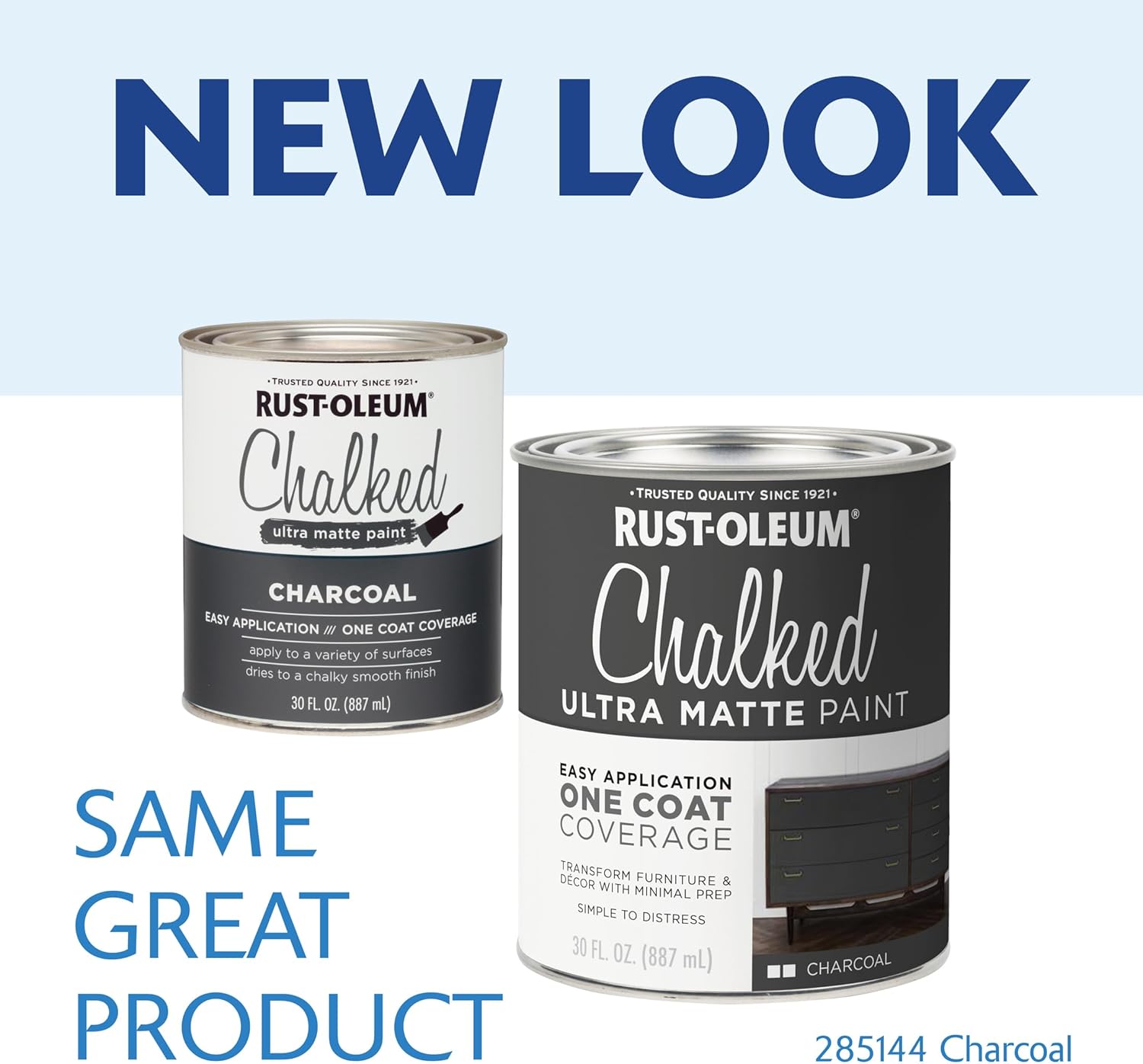
Rust-Oleum’s Chalked Paint line is the most accessible entry in the category — widely available at major home improvement retailers, priced around $12–$16 per quart, and backed by Rust-Oleum’s published product data sheets that specify a smooth, ultra-matte finish with adequate adhesion to most surfaces without primer. The formula is thinner than Annie Sloan, typically requiring an additional coat to reach equivalent coverage, and the palette is more limited.
The critical trade-off for table refinishers: Rust-Oleum Chalked Paint is explicitly compatible with Rust-Oleum’s own Chalked Ultra Matte Topcoat, and the brand also supports application of their water-based Varathane or Triple Thick polyurethane as a hard topcoat. This is the most important thing to understand about this product relative to dining or work tables. Bob Vila’s wax-vs.-polyurethane topcoat guide is direct on this point: a water-based polyurethane applied over a chalk paint base that has not been wax-sealed provides meaningfully harder protection than wax alone, and it’s the right chemistry for a table surface that will see daily use.
Rust-Oleum’s data sheets also specify drying and recoat windows clearly — typically one hour between coats, with full cure at thirty days — which aligns with real-world reviewer reporting on project timelines.
Rust-Oleum verdict for tables: Our pick for practitioner-level DIYers refinishing dining tables, kitchen tables, or any surface that will take daily contact. The lower price per quart makes full coverage more budget-friendly, the polyurethane topcoat compatibility solves the durability problem, and the published spec sheets give you predictable working behavior.
Dixie Belle Paint Company
Dixie Belle occupies a middle tier — priced around $18–$25 per quart — and has built a strong following among furniture flippers and intermediate DIYers. The brand’s formulation is notably thick, which reviewers consistently report as a coverage advantage (often achieving solid coverage in two coats on furniture with complex profiles). Dixie Belle’s own Gator Hide topcoat is a water-based sealer positioned as more durable than wax and easier to apply than polyurethane, and it appears frequently in long-run project documentation from furniture restoration communities.
This Old House’s furniture paint durability overview groups Dixie Belle in the “mid-durability” tier for horizontal surfaces — better than wax-only finishes, performing comparably to entry-level water-based polyurethanes in normal use conditions. Where Dixie Belle underperforms relative to Rust-Oleum’s polyurethane option is in heat and moisture resistance: owners refinishing outdoor-adjacent tables or tables near heat sources note earlier breakdown of the Gator Hide topcoat than comparable Varathane applications.
Dixie Belle verdict for tables: A strong choice for indoor dining tables where the thicker formula and Gator Hide’s ease of application are attractive, and for refinishers who want mid-range protection without navigating polyurethane application. Not the first choice for outdoor or semi-outdoor tables.
The Topcoat Is Not Optional: A Short Number Block
The most consequential single decision in chalk-painted table refinishing is topcoat selection. Here’s how the main options compare on the metric that matters most for tables — surface hardness at full cure, as expressed in published pencil hardness ratings where available, and practical review patterns where not:
| Topcoat | Chemistry | Hardness / Durability Tier | Best For |
|---|---|---|---|
| Paste wax (e.g., Annie Sloan Soft Wax) | Carnauba/beeswax blend | Low — requires re-application 2x/year | Decorative, low-traffic pieces |
| Water-based polycrylic (e.g., Minwax) | Acrylic polymer | Medium — adequate for light table use | Side tables, occasional-use dining |
| Water-based polyurethane (e.g., Varathane) | Urethane polymer | High — rated for floor-level abrasion in some formulas | Daily-use dining and work tables |
| Oil-based polyurethane | Alkyd-urethane | Very high — yellows over light colors | Work tables; not recommended over white/gray chalk |
Source: Bob Vila’s wax-vs.-polyurethane topcoat guide; Rust-Oleum product data sheets.
One non-negotiable rule that experienced refinishers document consistently: never apply a water-based polyurethane over a wax-sealed chalk paint layer. The wax creates a barrier the polyurethane cannot bond to. The result is peeling within weeks. If you’ve already waxed and want to upgrade to polyurethane protection, the chalk layer must be stripped and the surface prepared again.
Surface Prep: The Variable Brands Won’t Advertise
Every chalk paint brand leads with “no prep required” or “minimal prep” messaging because it’s a genuine selling point. For vertical surfaces on furniture that won’t take daily contact, this is largely accurate. For tables, it requires more nuance.
Apartment Therapy’s DIY chalk paint surface prep and failure analysis documents a consistent pattern in reader project submissions: tables refinished without light sanding (180-grit is adequate — this just means scuffing the surface so the new paint has something to grip) on previously finished surfaces show higher rates of early delamination than those with minimal prep. “No primer needed” and “no sanding needed” are true statements about chalk paint’s adhesion chemistry — but on a table that previously had a glossy lacquer or polyurethane finish, a light scuff dramatically improves long-run adhesion of the chalk layer itself.
This is a fifteen-minute step that year-two results will either reward or punish.
The Decision Rule
If you’ve read this far, you’re probably sitting with a specific table and a current decision. Here’s the framework:
-
If the table is decorative or low-traffic (an entry console, a side table, a display piece): Annie Sloan with lacquer topcoat gives you the richest finish depth and the widest color range. The higher cost per quart is justified by the formula quality.
-
If the table is a daily-use dining or work surface: Rust-Oleum Chalked Paint paired with Varathane water-based polyurethane is the combination that holds up. Lower cost gives you margin for a proper multi-coat finish and a full-cure waiting period before putting the table back into service. Budget for thirty days of cure time before evaluating the finish’s true durability.
-
If ease of topcoat application matters more than maximum hardness: Dixie Belle with Gator Hide is a legitimate mid-ground for indoor dining tables. Owners who’ve documented multi-year projects report adequate performance in normal household conditions.
-
If you’ve already waxed and are seeing early wear: Strip to bare wood, prep with 180-grit, and start the finish system fresh. Patching a wax-sealed surface with polyurethane will fail.
Year two is where chalk paint projects are honestly evaluated. The brands that look equivalent on day one diverge significantly by month eighteen — and the divergence is almost always explained by topcoat chemistry and prep decisions made before the first stroke of a brush.