May 18, 2026 • Maren Calloway • 9 min reading time • Prices verified June 6, 2026
Chalk Paint Brushes and Wax Topcoats for Table Surfaces: What the Spec Sheets Don't Tell You
If you’ve ever rolled up your sleeves to transform a secondhand table with chalk paint — a thick, matte, water-based paint formulated to grip almost any surface without heavy sanding — you’ve probably discovered that the paint itself is only half the project. The other half is the finishing system: the brush you apply it with and the wax topcoat you seal it with afterward. A wax topcoat is a paste or liquid protective layer, typically made from carnauba or beeswax blended with petroleum distillates, that cures on top of the painted surface to resist moisture, scuffs, and daily wear. The spec sheets for these products — the technical documents manufacturers publish with application rates and dry times — read cleanly. In practice, the gaps between what the label promises and what owners actually experience on a horizontal table surface (versus a vertical cabinet door) are significant enough to change your buying decision. This article breaks down those gaps in plain terms, with the trade-offs named explicitly so you can match your finishing system to your actual use case.
Why Table Surfaces Are a Different Animal Than Cabinets or Chairs
Almost every chalk paint and wax tutorial you’ll find online — and the guidance in both the This Old House chalk paint editorial and the Bob Vila best-chalk-paints buyer’s guide — defaults to vertical furniture: dresser fronts, cabinet doors, chair rails. That framing is not an accident. Vertical surfaces drain excess product, show brush marks less aggressively, and experience friction from hands rather than sustained pressure from dishes, laptops, and elbows.
A table top changes every variable:
Gravity works against you during application. Wax pools in corners and low spots on a horizontal plane. Owners on long-run finishing forums consistently report that the “thin, even coat” instruction on Annie Sloan’s wax documentation translates beautifully to a cabinet door and produces blotchy buildup on a dining table — particularly in the center where brushes make their longest strokes.
The surface absorbs impact and abrasion differently. A chair gets sat on; a table top gets scraped across by ceramic mugs, dragged by laptop edges, and spotted by condensation rings. The Spruce’s finishing guide notes that wax topcoats require a full 30-day cure before they reach maximum hardness — a timeline most owners underestimate when they read “dry to the touch in 24 hours” on the label. Those are two different states: touch-dry means the solvent has flashed off; cure-hard means the wax has fully polymerized into a protective film. Using the table at 24 hours and blaming the wax for softness is the most common pattern in aggregated reviews.
Brush choice compounds the problem before the wax stage even arrives. The chalk paint coat underneath the wax needs to be smooth enough that the wax sits uniformly on top of it. A bristle brush that leaves heavy texture — what finishers call “lap marks” or “drag lines” — creates valleys that hold more wax and ridges that hold less, resulting in uneven sheen and uneven protection.
Brush Selection: The Three Formats and Their Real Trade-Offs
Chalk paint brushes fall into three categories that spec sheets treat as interchangeable. They are not.
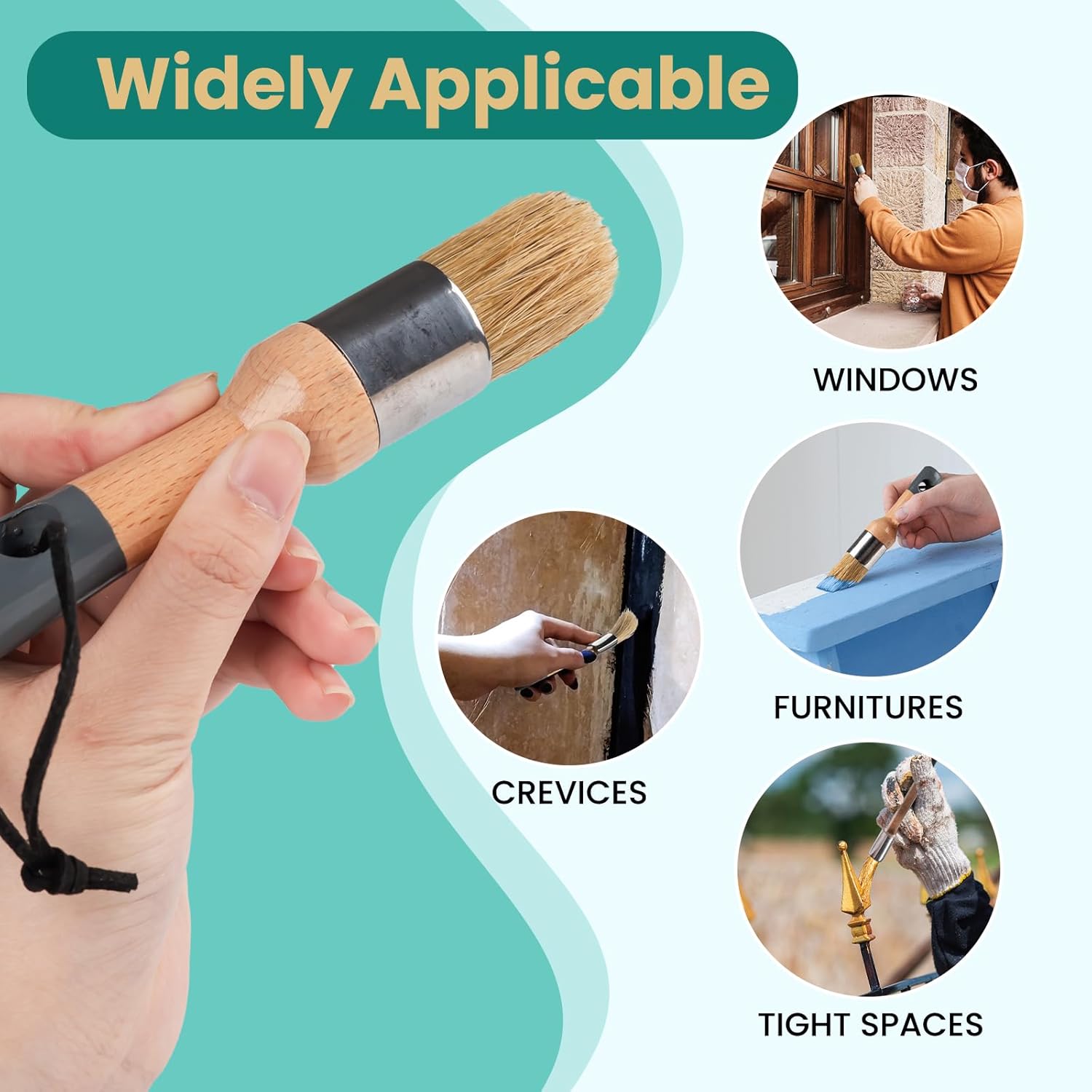
Round, thick-bristle “chalk brushes” (the style Annie Sloan’s product line is built around) are designed to work paint into carved or turned surfaces with a stippling motion. On a flat table top, that same motion creates stipple texture that telegraphs through a wax coat. Owners consistently report visible brush marks as a top complaint when using this format on large flat surfaces. If your table has a carved apron or turned legs and a flat top, this brush is excellent for the detail work and a liability for the field.
Flat bristle brushes, 3–4 inches wide, are what professional furniture painters default to for flat surfaces. The Spruce’s finishing guide specifically calls out a wide, flat bristle brush as the preferred tool for minimizing lap marks on horizontal planes. Published application guidance from Rust-Oleum’s Chalked Paint product data sheet recommends applying in long, overlapping strokes — a technique that works with a flat brush and fights a round stippling brush.
Foam rollers (4-inch) are the underrated option for achieving the smoothest possible chalk paint base coat on a large table top. Good Housekeeping’s chalk paint roundup notes that foam application reduces brush marks to near zero but can introduce micro-bubbles if the paint is worked too fast. The workaround is a slow, single-direction pass. The trade-off: foam gives you almost no “working time” to blend edges before the paint skins, which matters on tables wider than 30 inches.
The decision rule for brush selection:
- Flat table top, 24 inches or wider, no carved detail → flat bristle or foam roller for the field coat
- Carved apron, turned legs, or decorative molding → round chalk brush for detail work only
- Combination table → buy both; don’t compromise one to do both jobs
Wax Topcoat Selection: Clear vs. Dark, Hard vs. Soft, and the Durability Gap
Wax products divide into two functional families that the spec sheets rarely explain in plain terms: soft waxes (paste or cream consistency, higher oil content, easier to buff) and hard waxes (denser, often requiring more working heat from friction to level). For table surfaces specifically, the hardness hierarchy matters.
Clear soft wax — Annie Sloan Clear Chalk Paint Wax is the category reference — is the most commonly recommended beginner product, and it earns that position. Per Annie Sloan’s wax application documentation, it is formulated for ease of application and produces a low-sheen matte finish consistent with the chalk paint aesthetic. The trade-off: soft wax requires more frequent reapplication on table surfaces. Owners in long-run reviews note that a dining table receiving daily use shows wax depletion — visible as dull, dry-looking patches — within 6 to 9 months without a maintenance coat.
Dark or antiquing wax is a soft wax tinted with pigment to settle into surface texture and create an aged appearance. On a table top, this product is a stylistic choice, not a performance upgrade. Its durability profile is identical to clear soft wax. If your table is intended to look and function clean, skip the dark wax.
Hard finishing waxes — products like Briwax Original (a solvent-based hard wax) or General Finishes Wax (water-based, harder cure) — provide a more durable film at the cost of a steeper application learning curve. These products require more vigorous buffing to level, but the resulting surface is meaningfully harder. The Spruce’s chalk paint finishing guide distinguishes between paste waxes designed for decorative furniture and hard finishing waxes designed for working surfaces, noting that the latter perform substantially better under abrasion.
The durability gap, by the numbers:
| Wax Type | Typical Recoat Interval (table surface, daily use) | VOC Level | Cure Time to Full Hardness |
|---|---|---|---|
| Soft paste wax (Annie Sloan-style) | 6–9 months | Low | 30 days |
| Hard finishing wax (Briwax-style) | 12–18 months | Moderate–High | 21–30 days |
| Water-based hard wax (General Finishes) | 10–14 months | Low | 28–35 days |
Intervals derived from aggregated owner reports and manufacturer maintenance guidance; actual results vary by use intensity.
The Two Failure Modes Spec Sheets Don’t Prepare You For
Ghosting under wax. “Ghosting” refers to the faint, semi-permanent impression of previous marks — condensation rings, adhesive residue, pressure marks — that remain visible after the surface is cleaned. Ghosting happens when the chalk paint base coat absorbs a contaminant before wax is applied and the wax then locks that contaminant in. The spec sheet instructions say “apply wax after paint is dry.” What they don’t say: any contamination event between the final paint coat and the wax coat is permanent. On a table used by a household during the painting project — a common scenario — even a glass set down on an unwaxed surface can ghost. The mitigation is sequencing: paint and wax the table in a single work session, or cover the surface completely between coats.
Wax buildup opacity. Multiple wax coats without stripping create a yellowing, cloudy layer over time, particularly under light-colored chalk paint. This is a documented aging characteristic of petroleum-distillate waxes, noted in the Bob Vila chalk paint guide’s maintenance section. The fix is periodic stripping with mineral spirits, which removes the wax layer without disturbing a well-cured chalk paint base coat underneath — but this is a step that exactly zero product labels mention during the purchase decision.
If X, Then Y: The Decision Rules for Your Finishing System
This section is the synthesis. Here’s how to translate the trade-off map above into a purchasing decision.
If your table is in a low-traffic zone (a decorative side table, a display surface, a staging piece) and you want maximum period-correct chalk paint aesthetics: use a round chalk brush for the paint coat, clear soft wax for the topcoat, and plan for a maintenance coat every 9–12 months. The surface will look exactly as the spec sheets picture it.
If your table is a working surface (dining table, kids’ activity table, craft table) and durability is the priority: use a flat bristle brush or foam roller for the paint coat to minimize texture, apply a hard finishing wax or a water-based hard wax, and commit to the full 30-day cure before returning the table to regular use. Owners who shortcut the cure window account for the majority of “the wax scratched immediately” complaints in aggregated reviews.
If you’re doing a commercial or hospitality piece — a chalkboard-top display table for a café or restaurant — soft wax is the wrong topcoat category entirely. Per Good Housekeeping’s chalk paint roundup notes on commercial applications, surfaces subject to daily cleaning with commercial sanitizers need a film-forming topcoat (water-based polyurethane over the paint, not wax) to resist chemical degradation. Wax topcoats and quaternary ammonium sanitizers are chemically incompatible; the sanitizer strips the wax film on contact.
If budget is tight and you’re choosing one brush: a 3-inch flat bristle brush is the single most versatile tool across chalk paint application and wax application on table surfaces. It won’t be the optimal tool for either job at the edges, but it won’t compromise either job the way a round stipple brush compromises a flat field coat.
The spec sheets will show you what the products are rated for. What they won’t show you is what order the decisions need to happen in, or which combinations quietly undermine each other. That’s the gap this guide is meant to close — so you spend the weekend painting, not troubleshooting.