September 25, 2026 • Maren Calloway • 10 min reading time • Prices verified June 6, 2026
Chalkboard Paint on Non-Wood Surfaces: Metal, Glass, Tile, and Walls — What Sticks and What Peels
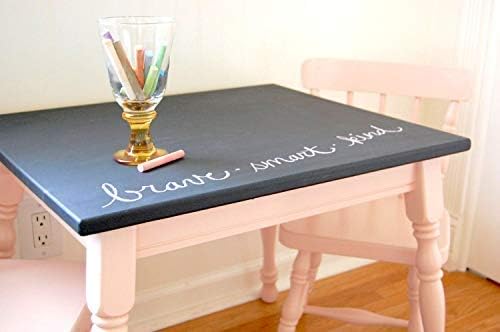
Chalkboard paint — a specially formulated coating that dries to a matte, chalk-receptive finish — has expanded well beyond its original home on wood and drywall. Today it shows up on refrigerator doors, bathroom tiles, metal lockers, glass cabinet fronts, and repurposed whiteboards. The idea is straightforward: coat almost any surface and turn it into a writable, erasable chalkboard. But “almost any surface” is doing a lot of work in that sentence. The substrate you start with — the raw material underneath the paint — controls everything from how many coats you need, to whether the finish peels in six months or lasts six years. If you’ve already done one or two chalkboard paint projects on wood and you’re now eyeing a metal shelving unit or a wall of glazed tile, this guide is the next conversation you need to have. We’ll walk through the four most common non-wood surfaces, name the tradeoffs honestly, and give you a clear decision framework before you buy.
| EDITOR'S PICKChalkboard Blackboard Paint - B… | Mid-tierRust-Oleum 206540 Chalkboard Br… | Budget pickRust-Oleum 1913830 Chalkboard S… | |
|---|---|---|---|
| Size | 8.5 oz | 30 oz | 11 oz |
| Application | Brush-on | Brush-on | Spray |
| Finish | Matte | — | — |
| Non-toxic | ✓ | — | — |
| Wet-erase pen use | ✓ | — | — |
| Price | $17.97 | $16.49 | $6.29 |
| See on Amazon → | See on Amazon → | See on Amazon → |
Why the Substrate Changes Everything
Wood is forgiving because it’s porous — paint soaks in slightly, creating mechanical adhesion (a physical bond where paint grabs onto microscopic surface texture). Metal, glass, and glazed tile are non-porous. Paint has nothing to grab. That’s not a dealbreaker, but it changes your prep protocol completely and it changes which formulas perform.
The pattern across aggregated reviewer feedback on brush-on chalkboard products is consistent: the failures — peeling, chipping, uneven coverage — almost always trace back to skipped prep on non-porous surfaces, not the paint itself. Conversely, the best outcomes on difficult substrates come from reviewers who document their full process: sanding, cleaning, priming, then painting. That sequence isn’t optional on metal or glass; it’s the product.
A second variable that shows up repeatedly in reviewer accounts is paint separation. Chalkboard paint is denser than standard latex wall paint, and the pigment and texture agents can settle during storage. On a quick wood project you might not notice. On a non-wood surface where you’re laying down three or four coats with drying time between each, the can sits open longer and separation becomes a real mid-project problem. The fix is simple — stir continuously, not just at the start — but it’s worth knowing before you’re halfway up a tile wall.
Metal: The Best Non-Wood Candidate, With Conditions
Metal is arguably the most rewarding non-wood surface for chalkboard paint when prepped correctly — and the most punishing when it isn’t. Reviewers who report success on metal surfaces consistently follow the same sequence: light sanding with 220-grit sandpaper to scuff the surface (creating that mechanical adhesion that smooth metal won’t provide on its own), a wipe-down with a degreaser or isopropyl alcohol to remove oils and residue, and a bonding primer rated for metal before the chalkboard topcoat goes on.
One reviewer’s refrigerator door conversion — documented in detail across multiple product review threads — is a standout real-world use case. The approach involved using painter’s tape to mask a calendar grid directly onto the appliance surface, then painting each section. The result was a functional, room-integrated chalkboard calendar. That’s a genuinely clever application that also reveals something useful: painter’s tape adhesion on finished metal is predictable and clean, which makes geometric masking on metal easier than on textured drywall.
The tradeoff to name explicitly: bare or galvanized metal can cause adhesion failure and rust bleed-through if you skip primer, and not just any primer — you want an etching primer or a product explicitly rated for metal bonding. Rust-Oleum’s product data sheet for their chalkboard formulas notes compatibility with primed metal surfaces; the specification stops short of recommending direct-to-bare-metal application without a primer coat. Bob Vila’s editorial review roundup on chalkboard paints echoes this, flagging primer as non-negotiable on slick metal substrates.
Decision rule: If you’re painting a powder-coated (factory-finished with a baked-on coating) or painted metal surface that’s in good condition, 220-grit scuff + clean + chalkboard paint is often enough. Bare metal, galvanized metal, or anything with rust spotting needs an etching primer first, full stop.
Glass: High Ceiling, High Prep Bar
Glass is the substrate that splits the reviewer pool most sharply. On one end: people who sanded lightly, cleaned with alcohol, applied two coats, and got a beautiful result. On the other: people who skipped sanding entirely, applied paint, and watched it peel in sheets within two weeks.
The physics here are unforgiving. Glass is the least porous surface you’ll encounter in a household project. Without a scuffed surface for paint to grip, adhesion relies entirely on the bonding chemistry of the primer — and most standard primers aren’t formulated for glass. Reviewers who document success on glass almost universally use either a glass-specific bonding primer or a self-etching primer (a product that contains a mild acid to microscopically roughen the surface), followed by thin coats of chalkboard paint.
The FolkArt Multi-Surface formula earns consistent praise specifically in contexts where surface quality matters. Reviewers note it delivers what one described as “classic chalkboard texture like you EXPECT” — a matte, slightly toothy finish — as opposed to competitors that cure to a finish that “feels like plastic.” On glass, where the visual and tactile result is fully exposed (no wood grain underneath to add character), that texture difference is more noticeable than on any other substrate.
By the numbers:
- Recommended coats on glass: 3–4 (vs. 2 on wood)
- Cure time before chalk seasoning: minimum 24 hours; 72 hours recommended for glass
- Coverage per 30 oz can (brush-on formula): approximately 50–75 sq ft on smooth non-porous surfaces vs. 75–100 sq ft on wood, per manufacturer specification data
Decision rule: If the glass piece is fixed in place (a cabinet door, a window panel), invest in self-etching primer and plan for four coats. If it’s a removable piece like a picture frame insert or a small tray, consider whether chalkboard contact paper (a peel-and-stick film alternative) gives you a better risk-adjusted outcome — it peels cleanly and requires no cure time.
Tile: The Hardest Surface to Get Right — and a Genuine Success Story
Glazed ceramic or porcelain tile is the most challenging substrate in this guide. The surface is engineered to repel liquids and stains — which is exactly what makes it useful in kitchens and bathrooms, and exactly what makes paint adhesion difficult.
The standout real-world data point here comes from a teacher reviewer who applied chalkboard paint to school tiles — noting explicitly that the tiles were “impossible to paint without chipping” with standard formulas, and that the specific product they chose was “the only chalkboard paint that worked” in that application. That’s a highly specific, credible use case from someone with direct experience on institutional-grade glazed tile. Writers at This Old House who cover chalkboard wall applications flag tile as requiring scuff sanding plus primer as a baseline, with the caution that grout lines create a secondary adhesion variable that flat wall applications don’t have.
Grout lines matter more than most guides admit. Paint applied over tile sits at two different heights — on the tile face and down into the grout channel — and the resulting surface is not flat. Chalk writing over a grid of grout lines produces a visibly uneven mark. For decorative backsplash applications where the chalkboard is used occasionally for notes or menus, this is cosmetic. For a heavily used chalkboard where legibility matters, it’s a functional limitation.
Decision rule: On glazed tile in a kitchen backsplash or bathroom, ask whether the goal is decorative or functional. Decorative (a small chalkboard section for notes or seasonal art) — proceed with full prep and accept the grout-line texture. Functional daily writing surface — the prep investment may not match the outcome; a framed chalkboard mounted above the tile is often a better answer.
Walls: Drywall and Plaster — The Reliable Middle Ground
Painted drywall and plaster sit between wood and the hard non-porous surfaces in terms of difficulty. Existing wall paint provides some tooth for adhesion, and flat or eggshell finishes are more compatible than semi-gloss or high-gloss paints, which behave more like a non-porous surface.
The Krylon brush-on formula earns a particularly detailed reviewer-sourced process document from someone who converted a whiteboard — including the full sequence of sanding the whiteboard surface, cleaning with degreaser, priming, and masking with painter’s tape before applying chalkboard paint. That step-by-step account is useful not just for whiteboard conversion (addressed in the FAQ below) but as a transferable prep framework for any wall surface with a slick existing finish. The principle is the same: more surface sheen on the existing coat means more prep you need to do before chalkboard paint goes over it.
One practical warning that surfaces consistently in multi-coat applications: paint separation mid-project. The heavier pigment load in chalkboard formulas means the paint settles faster than standard wall paint. If you’re doing a large wall and your coats are separated by two to four hours of drying time, stir the can before every coat, not just at the start. Reviewers who flag this note it’s especially relevant on large surface areas where the can is open for an extended period.
Frequently Asked Questions
Do you need to prime metal surfaces before applying chalkboard paint? For bare or galvanized metal, yes — a bonding or etching primer is necessary. Rust-Oleum’s published product specifications indicate compatibility with primed metal; skipping primer on bare metal risks both poor adhesion and rust bleed-through over time. On already-painted or powder-coated metal in good condition, a light 220-grit scuff plus clean may be sufficient, but a thin primer coat is still low-risk insurance.
Why does chalkboard paint sometimes separate in the can, and how do you fix it mid-project? The heavier texture agents and pigments in chalkboard formulas settle faster than standard paint. If you notice a watery layer on top or a thick sediment at the bottom, the paint has separated — stir thoroughly (two to three minutes with a mixing stick) until the consistency is uniform throughout. Stir before every coat on long projects, not just at the start.
How long should chalkboard paint cure before you season the surface with chalk? Manufacturer data sheets for major brush-on formulas generally specify 24 hours before light use, with 72 hours cited as the recommended full cure time. On non-porous surfaces like glass or tile, err toward the longer end — the paint hasn’t bonded as deeply and benefits from the full cure window before chalk contact.
What does “seasoning” a chalkboard surface mean, and why does it matter? Seasoning means rubbing the flat side of a piece of chalk across the entire surface and then wiping it off before first use. This fills the microscopic texture of the cured paint with chalk dust, which prevents permanent “ghosting” — the faint impression of your first chalk marks that can remain even after erasing if the surface is used unseasoned. Skipping this step is the single most common cause of new-owner frustration in the first month of use.
Can chalkboard paint be applied directly over a whiteboard surface without sanding? Reviewers who document this conversion consistently report that skipping sanding leads to adhesion failure. The melamine or porcelain surface on most whiteboards is engineered to be smooth and cleanable — meaning paint has minimal grip. The Krylon brush-on formula has reviewer-sourced documentation of a successful whiteboard conversion that includes sanding, degreasing, priming, and masking as explicit steps. Sanding is not optional on this substrate.
How many square feet does a 30 oz can of brush-on chalkboard paint realistically cover? On smooth non-porous surfaces (glass, metal, tile), plan for 50–75 square feet across the recommended coats. On painted drywall, coverage is closer to 75–100 square feet. These figures assume two to three coats; if you need four coats on a difficult substrate, buy accordingly. Per-coat coverage overstated on the label is a common reviewer complaint on non-wood projects — order one extra can before you start rather than stopping mid-wall to reorder.