September 11, 2026 • Maren Calloway • 11 min reading time • Prices verified June 6, 2026
Double-Sided Kids Art Easels: Chalkboard, Whiteboard, and Paper Roll — Where Pine Builds Outlast Particle Board
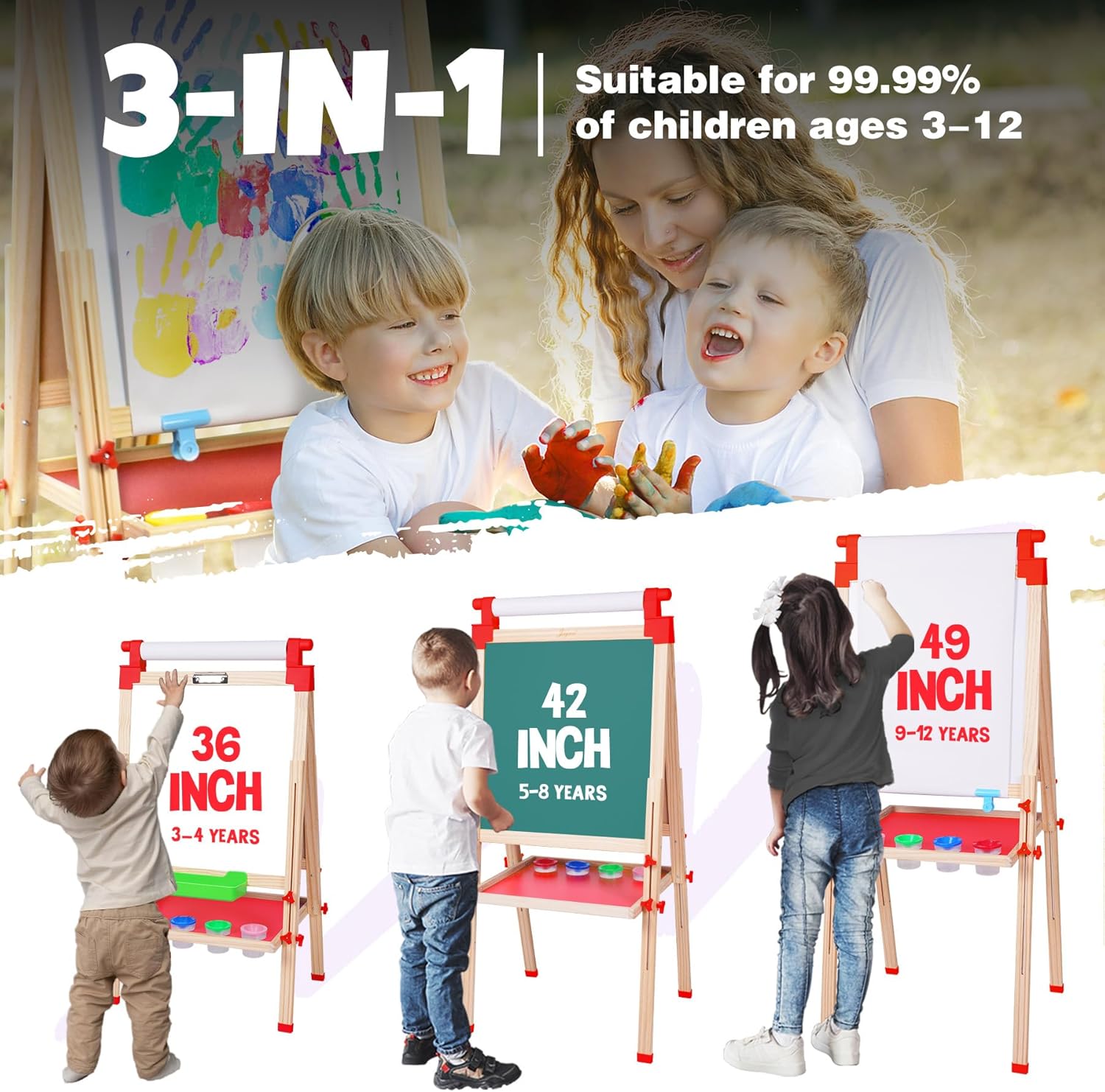
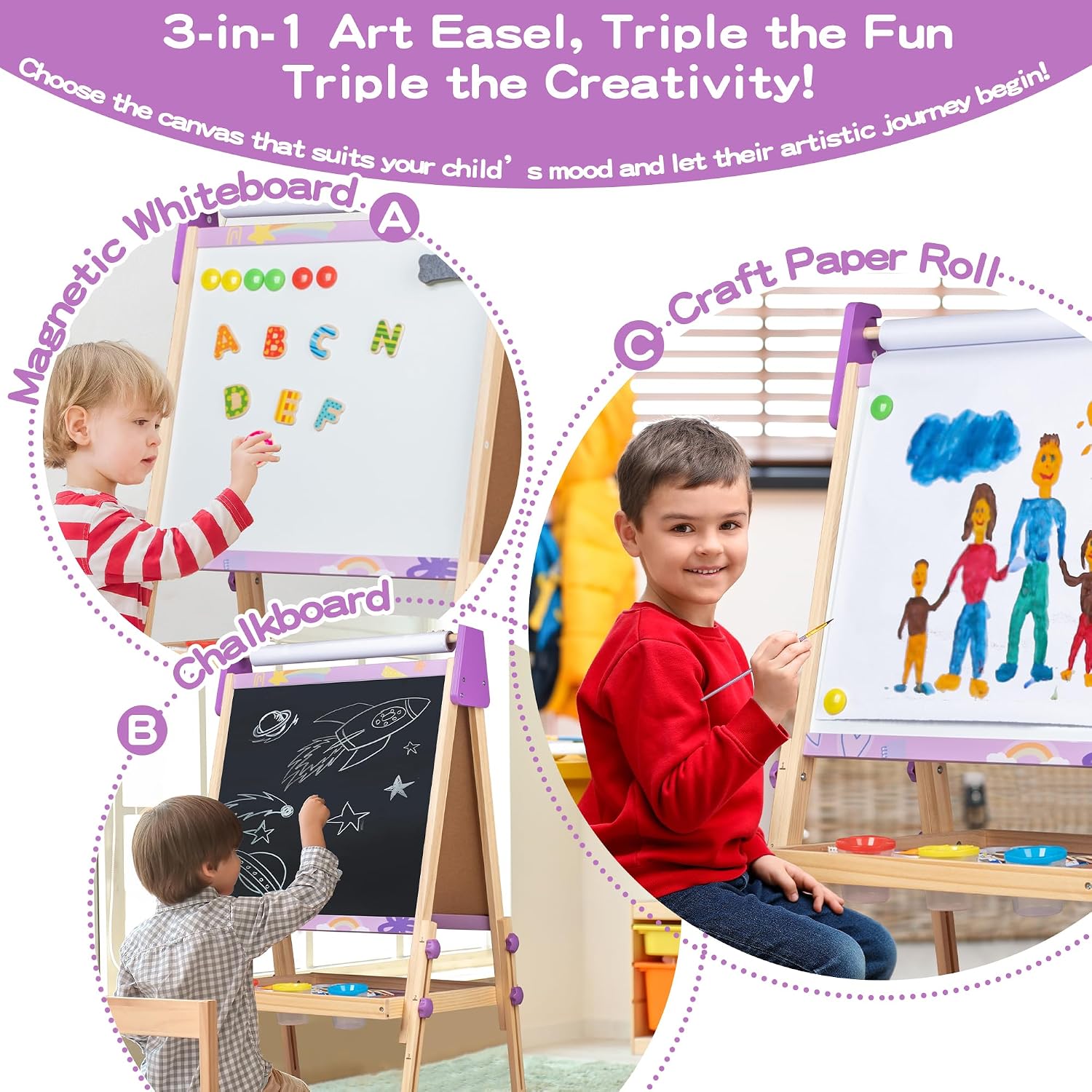
A double-sided kids art easel is exactly what the name promises: a freestanding A-frame — think a ladder that opens into a wide V — with a different art surface on each side. One panel is typically a chalkboard, a dark matte surface you draw on with chalk sticks, and the other is a magnetic whiteboard that accepts dry-erase markers and can hold magnets or lightweight papers. Many models add a horizontal dowel or clamp bar at the top to feed a paper roll, giving kids a third surface for painting or crayon work. What makes or breaks the experience after the first week isn’t the feature list; it’s the material under the paint. Pine-framed easels hold screws, survive repeated folding, and age gracefully. Particle board — compressed sawdust held together with resin — strips, swells, and wobbles. If you’re buying one of these for a child who will actually use it, that structural difference is the most important thing this guide will help you see before you click.
This article synthesizes aggregated owner reviews, published spec sheets, and editorial guidance from four named sources cited in plain text throughout: Good Housekeeping’s 2025 kids easel roundup, The Spruce’s easel buyer guidance feature, the Wirecutter kids art supplies overview published by The New York Times, and Apartment Therapy’s small-space art station coverage. We have not personally assembled or owned any of these products — our job is to surface the patterns so you don’t have to read 400 reviews yourself. Some product links on ChalkboardTable.com generate a small commission at no extra cost to you.
The Frame Material Decision: Why Pine vs. Particle Board Is the Only Spec That Matters at This Price
At the $40–$120 price band where most double-sided kids easels live, manufacturers compete on feature count rather than material transparency. You’ll see “solid wood” in marketing copy that, on closer reading, means “solid wood legs, particle board panels.” That distinction matters because the panels are where the hardware lives — the bolts that hold the A-frame angle, the screws that anchor the tray, the peg holes that allow height adjustment.
Particle board (also called MDF-core or engineered wood composite, depending on density) is cheaper to mill into flat panels, but it has a documented weakness around fasteners: over repeated tightening and loosening — exactly what happens when a child adjusts height or an adult folds the easel for storage — the material compresses and the screw loses grip. The Wirecutter kids art supplies overview, published by The New York Times, identifies stripping fasteners as a recurring durability complaint in the fifty-dollar-and-under easel category.
Pine, by contrast, is a softwood that holds fasteners well and resists splitting under normal play loads. It also accepts chalk paint and whiteboard coatings more uniformly, which is why higher-rated boards in this category tend to show fewer ghosting complaints. Ghosting, for anyone new to the term, is the faint residue of a previous drawing that won’t fully erase even after cleaning — a surface-quality failure caused by either a low-grade coating or a panel that absorbed moisture and warped slightly.
The Spruce’s easel buyer guidance feature reinforces this point: the editors recommend checking whether a listing distinguishes between leg material and panel material, because the two are often different woods sold under a single “solid wood” claim.
The frame-quality signal that’s easiest to check before buying: look for reviews that describe the easel after six to eighteen months of use, not just assembly-day impressions. Particle board failures are almost never visible at unboxing; they appear at month three when a bolt starts spinning without biting.
The Three-Surface Format: Chalkboard, Whiteboard, and Paper Roll
Chalkboard Panel
The chalkboard side on kids easels is almost universally MDF or HDF (high-density fiberboard) with a factory-applied chalkboard paint coating — not slate, not tempered glass. This matters for two reasons.
First, chalk type matters more than it does on slate. Traditional chalk sticks work on every chalkboard surface. Liquid chalk markers — the paint-pen style popular for home menu boards — are a different story. On a factory-painted MDF surface, liquid chalk markers often stain permanently because the coating is porous. Parents who want to use liquid chalk markers should look for easels that explicitly list a sealed or glazed chalkboard panel, or accept that liquid chalk will likely ghost.
Second, seasoning improves first use. Seasoning a new chalkboard means rubbing the flat side of a chalk stick over the entire surface, then erasing it before the first drawing session. This fills the surface pores and prevents the first drawing from imprinting permanently. It’s a two-minute step, but the majority of negative first-week reviews trace back to skipping it.
Whiteboard and Magnetic Panel
The magnetic whiteboard side’s magnet strength varies widely and is almost never specified in product listings. Aggregated owner reviews suggest a practical rule: if the listing doesn’t mention “magnetic” or “magnets included” in the title or bullet points, assume the panel is whiteboard only. Good Housekeeping’s 2025 kids easel roundup flags that the best magnetic panels in this category use a steel backer behind the whiteboard coating; cheaper versions use a thin metallic film that loses magnetism near the edges.
Paper Roll
The paper roll feature is almost universally positive in owner reviews — the mechanic is simple (a dowel and a tear bar), replacement rolls are inexpensive and widely available, and it turns the easel into a paint or marker station without mess migration. The one friction point: roll width is not standardized. Most kids easels accept twelve-inch or fifteen-inch rolls. Check your easel’s dowel width before ordering replacements, because a fifteen-inch roll on a twelve-inch dowel will sag and tear unevenly.
Comparing the Top Picks: Build Quality Patterns Across the Category
Budget Pick: JOYOOSS Double-Sided Easel
The JOYOOSS easel generates a distinctive review pattern: emotionally warm, with multiple reviewers describing children who carry the easel from room to room rather than leaving it stationed in one spot. Portability — low weight, a balanced A-frame that a child can grip independently — is an underrated purchase driver in this category. If your scenario involves a child who will actively move their own art furniture, the JOYOOSS’s lightweight build is a genuine advantage rather than a materials compromise.
The tradeoff is the one you’d expect at this price tier: the panels are MDF rather than solid pine throughout, which means fastener longevity is medium rather than high. For families who will use the easel casually — a few times a week rather than daily — that tradeoff is entirely reasonable. For daily heavy use, read on.
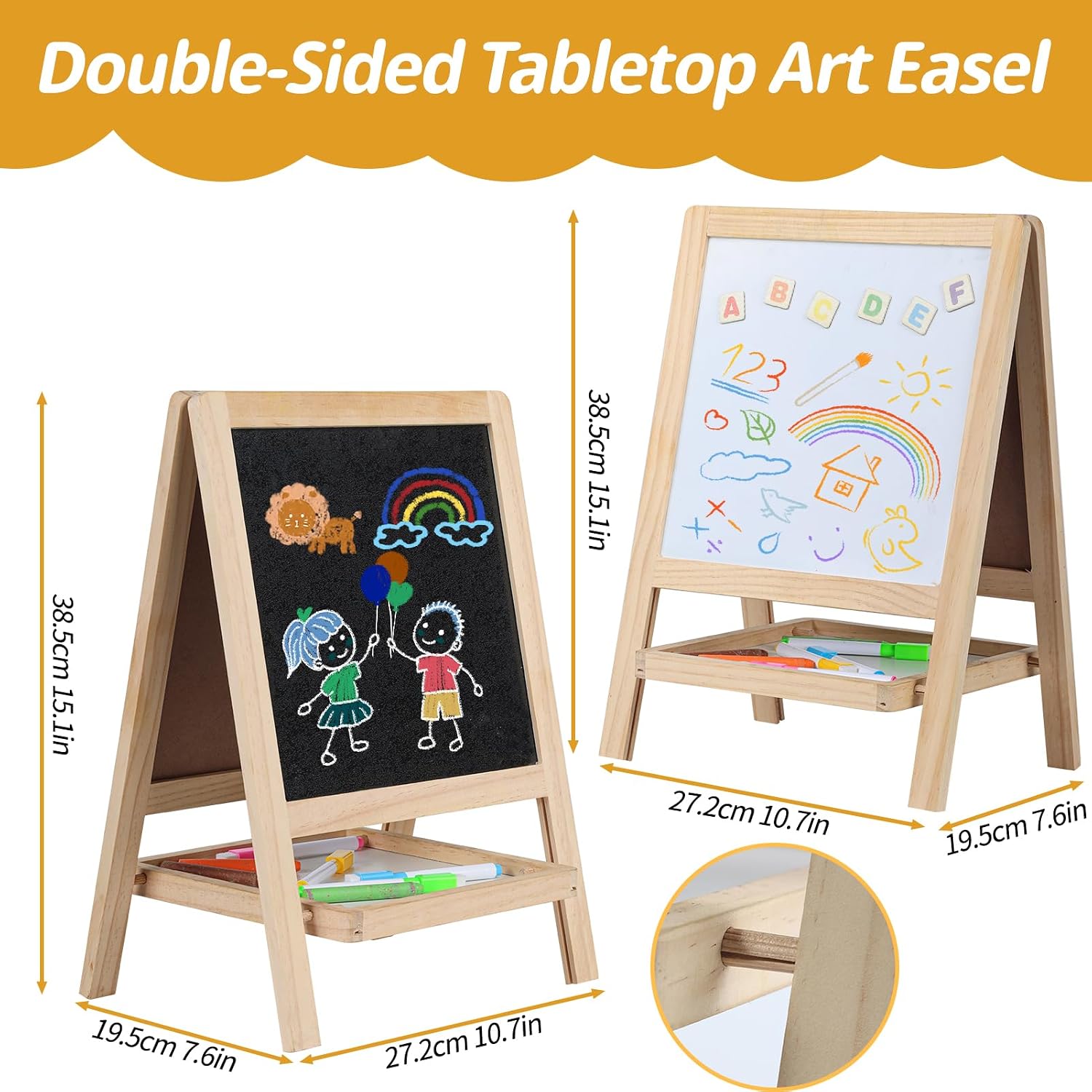
Tabletop
$29.99
In stock on Amazon
Check price on AmazonMid-Tier Pick: WINGYZ Double-Sided Art Easel
Across aggregated reviews of the WINGYZ double-sided easel, the pattern splits clearly. The majority of buyers describe solid assembly, a sturdy A-frame, and a chalkboard surface that erases cleanly after seasoning. A notable minority, however, report receiving wood components that arrived already marked with paint or stain — evidence of quality-control inconsistency at the factory level rather than in-transit damage.
This is worth naming plainly: if you order the WINGYZ and the wood arrives pre-marked, it is a documented pattern, not a one-off. Most sellers process returns or replacements without friction when the issue is documented with photos at unboxing. The WINGYZ sits in the mid-tier because its pine-forward frame delivers genuine durability for the price — the QC variability is a known friction point, not a structural failure mode.
JOYOOSS
$69.99
In stock on Amazon
Check price on AmazonPremium Pick: 3-in-1 Adjustable Double-Sided Easel with Accessory Tray
The 3-in-1 adjustable easel in this category attracts a notable cluster of grandparent-assembler reviews — buyers who assemble it as a gift rather than for themselves. These reviews consistently praise the clarity of the assembly instructions, which signals something meaningful: the instruction manual was designed for a first-time builder, not someone who assembles flat-pack furniture regularly.
Apartment Therapy’s small-space art station coverage notes that easel assembly complexity is frequently underestimated by gift-givers, making instruction clarity a genuine differentiator worth paying for at the premium tier. The height-adjustment range on this model also accommodates children from roughly age three through age eight, which extends the useful product life meaningfully compared to fixed-height budget options.
3-in-1
$72.99
In stock on Amazon
Check price on AmazonBuild Quality at a Glance
| Frame Type | Fastener Longevity | Ghosting Risk | Typical Price Band | Tier |
|---|---|---|---|---|
| Solid pine frame + pine panels | High — screws bite and hold | Low | $70–$120 | 3-in-1 — $72.99 |
| Pine frame + MDF panels | Medium — panel edges can compress over time | Medium | $45–$85 | JOYOOSS — $69.99 |
| Particle board throughout | Low — stripping common at 6–12 months | Higher | $35–$65 | Tabletop — $29.99 |
Based on published material specs and aggregated long-run owner review patterns. ChalkboardTable.com has not independently tested these materials.
If X, Then Y: The Decision Rule
- If the child is under 3 and the primary use is at a table: choose a tabletop easel format. The lower surface height and contained footprint reduce tipping risk and keep the activity within a supervised workspace.
- If portability between rooms is a likely use case: prioritize a lightweight, balanced A-frame the child can grip independently — the JOYOOSS fits this description well.
- If this is a gift and the assembler will be working alone: the 3-in-1 adjustable easel’s instruction clarity makes it the lowest-friction solo-assembly option in this category.
- If long-term durability covering two or more years of daily use is the primary concern: filter for pine-framed models and read for six-month reviews rather than unboxing reactions. Inspect on arrival and document any pre-existing marks immediately with photos.
- If liquid chalk markers are part of the planned use: confirm a sealed panel specification before buying, or plan to use traditional chalk sticks only and season the board on day one.
Frequently Asked Questions
What age is a freestanding art easel appropriate for without tipping risk? Most freestanding double-sided easels are designed for ages three and up, and manufacturer-specified age floors are a reasonable guide. The tipping risk comes primarily from children pulling the tray or leaning on the panel rather than drawing on it — a behavior more common under age three. For children three through eight, a wide-base A-frame with a low center of gravity handles normal active use safely. Always confirm the A-frame is fully locked open before leaving a young child unsupervised.
Can one person assemble these easels alone, or is a second person needed? Most models in this category are technically solo-assemblable, but a second person makes the process faster and reduces the risk of panel scratches during alignment. Budget twenty to forty minutes. Easels with clearly designed instruction manuals — the 3-in-1 adjustable model stands out here based on reviewer feedback — are the most reliable solo-assembly options.
Do the chalkboard sides on kids easels accept liquid chalk markers or only traditional chalk? Traditional chalk sticks are safe on all panels. Liquid chalk markers frequently stain MDF and HDF panels permanently because the surface coating is porous. Unless the product listing specifically states a sealed or non-porous chalkboard surface, assume liquid chalk will ghost or stain.
How easy is it to replace the paper roll when it runs out? Very straightforward on most models — the dowel slides out, a new roll slides on, and the paper feeds through the tear bar. The key variable: confirm the replacement roll’s width matches your easel’s dowel before ordering. Most kids easels use twelve-inch rolls, but some use fifteen-inch.
Are the magnetic whiteboard sides strong enough to hold magnets and papers? This varies by model. Steel-backed panels hold standard alphabet and disc magnets without issue. Thin metallic-film panels — common in lower-price builds — lose strength at the edges and may not hold heavier magnet sets or papers reliably. Good Housekeeping’s 2025 kids easel roundup recommends checking product listings for explicit steel-backer claims and reading reviews for magnet-specific feedback before buying.
How does a tabletop easel differ from a freestanding easel for a toddler under age three? A freestanding easel stands on its own legs and is typically thirty-six to forty-eight inches tall at full height. A tabletop easel sits on a table or desk and has a drawing surface typically twelve to sixteen inches tall, which a seated toddler can reach without stretching. For under-three buyers, the tabletop format is often safer (no tipping risk from the easel itself), more ergonomic, and easier for an adult to supervise closely. The tradeoff is a smaller drawing surface and the need for a stable table to place it on.