September 7, 2026 • Maren Calloway • 10 min reading time • Prices verified June 6, 2026
Kids Activity Tables With Chalkboard Tops: What Two Years of Real Playroom Use Reveals
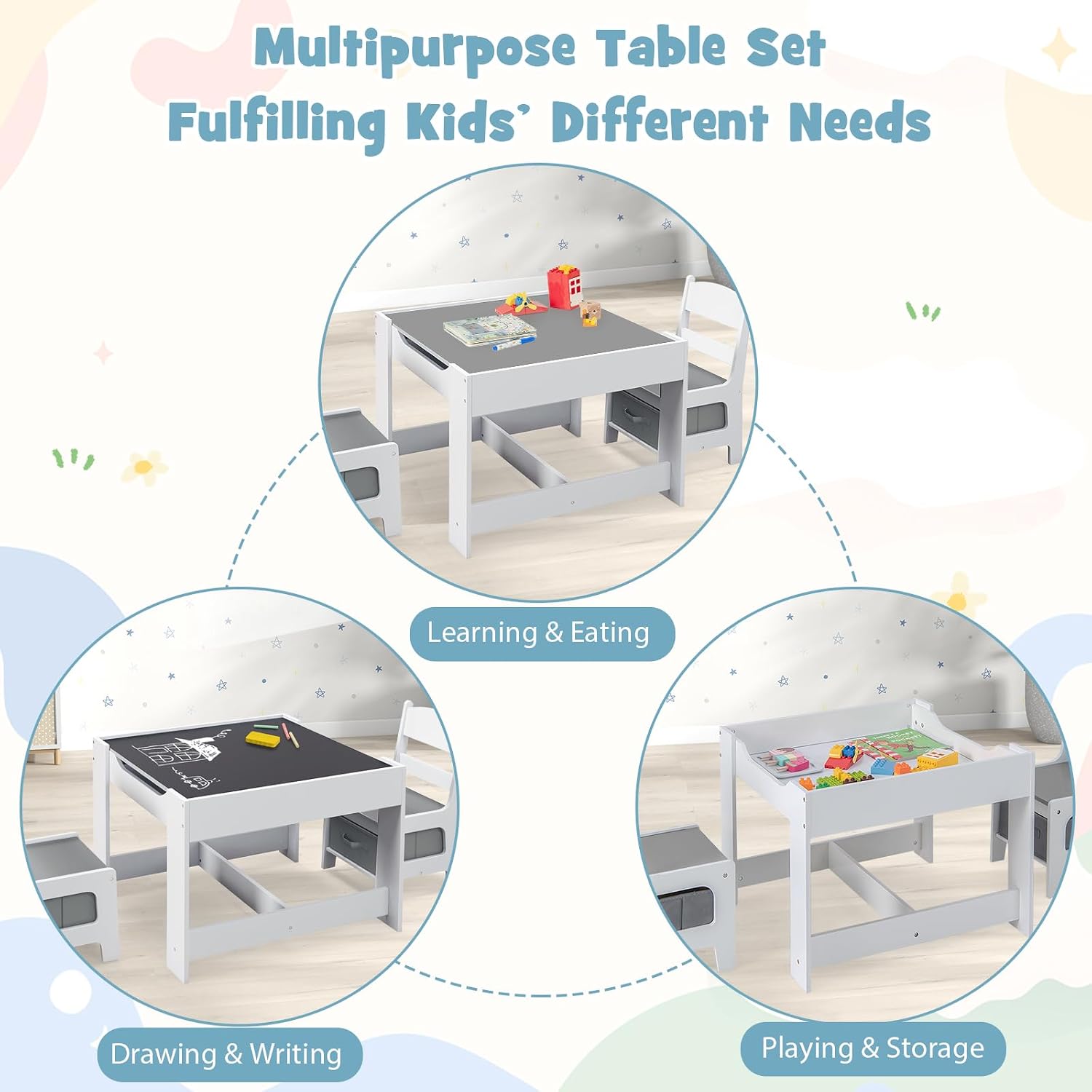
If you have spent any time watching a child draw on a chalkboard — one of those flat, dark-green or black surfaces you write on with chalk and wipe clean with an eraser — you already understand the appeal of a chalkboard activity table. It is a kids’ table whose surface is the chalkboard, so the whole tabletop becomes a canvas that resets in seconds. No paper to run out of, no markers bleeding through to the rug. For parents and educators, these tables sit in a sweet spot: durable enough for daily use, open-ended enough to support drawing, homework, and imaginative play across several years of childhood. The question — the one this article is built to answer — is which ones actually hold up after the honeymoon period, and what the real-world friction points are before you commit.
What follows is a synthesis of two-plus years of aggregated owner feedback across the most-reviewed mid-range wooden chalkboard activity table sets, cross-referenced against editorial picks from The Spruce and Good Housekeeping’s updated 2025 roundups. We have not owned or lab-tested these tables; our job is to read every spec sheet, forum thread, and review cluster so you do not have to, and to name our affiliate relationships clearly when they exist.
What Two Years of Daily Use Actually Looks Like
The headline finding from aggregated long-run reviews is that mid-range solid-wood frames genuinely hold up. The GTOLV kids’ activity table set is the clearest data point here: reviewers who document two full years of daily use — including arts and crafts, homework, Play-Doh sessions, and the inevitable chair-dragging — report no wobble development and no joint separation. That is not a given in the sub-$120 category, where MDF-framed alternatives frequently show corner stress at the twelve-month mark.
The pattern across Kinder King and Costzon sets is similar on the durability side, with one important caveat: both draw consistent mentions of assembly as a genuine friction point, not a minor annoyance. Multiple verified purchasers flag the tabletop-attachment step specifically as a two-person job, and at least one Costzon reviewer explicitly recommends searching for a YouTube walkthrough over relying on the paper instructions. If you are buying one of these as a solo-assembly solo parent — plan for 90 minutes and recruit help for the final tabletop lift.
By the numbers — mid-range chalkboard activity table sets:
| Factor | Typical rating (aggregated) | Long-run owner note |
|---|---|---|
| Frame durability at 24 months | Strong (4.4–4.7 / 5) | No wobble, joint integrity holds |
| Surface wipeability (liquid chalk) | Very good | Clean erase, low ghosting |
| Surface wipeability (standard chalk) | Moderate | Residue on some surfaces at 6+ months |
| Assembly difficulty | Moderate-high | Tabletop step requires two people |
The surface story is where things get nuanced, and it is worth spending a few minutes here because it is the most common source of post-purchase frustration.
The Chalkboard Surface: Not Quite What You’d Expect
Here is something the product photos do not communicate: the chalkboard surface on a kids’ activity table behaves differently from a freestanding chalkboard board, and the difference matters depending on how your child prefers to draw.
Liquid chalk markers — the kind with a felt tip that dispenses a water-based, opaque ink — perform well on virtually every mid-range table surface reviewed. Owners consistently report clean, full erasure with a damp cloth, and minimal ghosting (ghosting is the faint residue an image leaves behind even after wiping, which accumulates over time and muddies the surface). If your household runs on liquid chalk markers, you are in good shape.
Standard chalk — the dry, dusty sticks most people picture — is a different story on some surfaces. Several reviewers across the Kinder King and Costzon lines report that regular chalk erases less cleanly than it would on a proper slate chalkboard or a high-quality mounted board, particularly after six or more months of use. The surface texture on these tables tends to be a painted MDF or engineered wood finish rather than true slate, and painted surfaces can develop micro-abrasions over time that trap chalk dust. The practical fix most experienced owners land on: season the surface before first use (seasoning means rubbing the flat side of a chalk stick across the entire surface and then wiping clean — this fills the micro-pores and prevents a permanent “ghost” of the first image your child draws from being etched in) and commit to liquid chalk markers as the primary medium.
The Spruce’s 2025 activity table roundup flags this same distinction, noting that parents who switched from dry chalk to liquid chalk markers after early ghosting issues reported significantly higher long-term satisfaction. Good Housekeeping’s updated picks echo the recommendation to season any painted chalkboard surface before first use.
The Lipper International Desk and the “Dedicated Learning Spot” Effect
One of the more unexpected findings in the review literature is how emotionally specific the Lipper International children’s desk draws its fans. This is not a table set in the conventional sense — it is a single-child desk format — but it pulls an unusual concentration of reviews from parents using it specifically as a Kumon homework station, referencing the structured, worksheet-based supplemental learning program by name.
The pattern is worth naming explicitly because it reveals something about how a dedicated, fixed-purpose surface changes behavior. Parents describe the desk as creating a psychological “this is where we do our work” anchor for children as young as four. The chalkboard top pulls double duty: the child uses it for warm-up drawing before transitioning to paper worksheets, and parents use it to write the day’s tasks in liquid chalk marker where the child can see them. Several reviewers note that this setup — a visible, erasable task list at the child’s own surface — reduced homework resistance meaningfully compared to using a shared dining table.
If your use case has a structured learning component (not just open-ended play), the dedicated-desk format of the Lipper International is worth separating from the table-and-chairs set category in your evaluation. The trade-off is obvious: one child, one surface, less flexibility.
Height Adjustability and the 2–8 Age Range Question
The height-adjustable Montessori-style chalkboard activity table category — tables with legs that can be repositioned at multiple fixed heights, allowing the furniture to grow with the child — draws consistent praise in aggregated reviews for one specific reason: the math on longevity is compelling.
A fixed-height table sized for a two-year-old is typically the right height for roughly eighteen months before a growing child starts hunching uncomfortably. An adjustable table that spans the 2–8 age range extends the useful life to six-plus years, which changes the cost-per-year calculation significantly even if the sticker price is higher at purchase.
Owners of height-adjustable sets consistently report using the same table from toddler drawing sessions through early elementary homework — a claim that checks out against manufacturer-published height ranges. The trade-off is marginal assembly complexity (the height-adjustment mechanism adds steps) and, in some models, a slightly less robust feel at the joints compared to a fixed-leg solid-wood set. For households with multiple children at different ages, the flexibility wins. For a household with one child and a specific near-term use case, a well-built fixed-height set may be the more honest choice.
Frequently Asked Questions
Can I use liquid chalk markers on these activity table surfaces without ghosting?
Yes, with appropriate expectations. Across aggregated owner reviews, liquid chalk markers erase cleanly from virtually all mid-range painted chalkboard surfaces when wiped with a damp cloth — particularly when the surface has been properly seasoned before first use. Ghosting risk is low if you: (1) season before the first drawing session, (2) wipe with a damp cloth rather than a dry eraser, and (3) avoid letting marker sit for extended periods without wiping. Standard dry chalk is more ghosting-prone on painted surfaces than on true slate; liquid chalk markers are the safer long-run choice for these tables.
Do these tables hold up if a toddler climbs or jumps on them?
This is the question manufacturers do not answer directly, but the review literature does. Solid-wood frame sets — particularly the GTOLV and comparable mid-range wooden sets — show no structural failure in reviews where parents document toddler climbing. That said, no kids’ activity table in the $40–$120 range is designed or rated for standing or jumping loads, and reviews that describe intentional climbing are describing off-label use. The practical answer: a solid-wood frame with tight joints will survive the incidental climb far better than an MDF-frame set, but you should treat weight ratings on spec sheets as the actual ceiling and set expectations accordingly.
How long does assembly realistically take, and do I need two people?
Budget 60–90 minutes for a typical two-chair-plus-table set if you are experienced with flat-pack furniture, and closer to two hours if you are not. The tabletop attachment step — flagged in Kinder King and Costzon reviews specifically — benefits strongly from a second person to hold the surface level while you secure it. One person can do it alone, but reviewers who attempted solo assembly report significantly more difficulty and occasional misalignment. The YouTube-over-paper-instructions recommendation that appears in multiple Costzon reviews is well-earned: visual walkthrough videos for these specific models exist and are materially clearer than the included diagrams.
At what age can a child start using a chalkboard activity table?
Most mid-range sets are sized and rated from age three and up; some height-adjustable Montessori-style sets extend the stated range down to two. From a developmental standpoint, children as young as eighteen months can use a chalkboard surface under supervision, but the table’s stability and chair height matter more at that age than the surface type. Reviewers consistently describe the two-to-three range as the practical starting point for independent use.
Is the chalkboard surface on these tables the same quality as a standalone chalkboard board?
Honestly, no — and that is not necessarily a problem if you know what you are buying. Standalone chalkboard boards at comparable price points often use a slightly more refined painted surface or, at the premium tier, actual slate (a natural stone with superior erasability and no ghosting). Kids’ activity table surfaces are almost universally a painted MDF or painted wood finish, optimized for durability under physical table-use conditions rather than for maximum chalkboard performance. The gap is most noticeable with dry chalk; it is negligible with liquid chalk markers. If your child is a dedicated dry-chalk artist, a mounted chalkboard board will perform better as a drawing surface — the activity table wins on the full-room-setup, homework-station, and multi-year-longevity dimensions instead.
The Decision Rule
Here is the honest if-then summary this category earns after two years of owner data:
If your primary use case is open-ended daily play plus homework for a child aged two to eight, and you want a piece that holds up without wobble or surface failure, then a solid-wood mid-range chalkboard activity table set is the right call — budget for liquid chalk markers from day one and season the surface before first use.
If your child is a committed dry-chalk user or you need true professional chalkboard surface quality, then pair a simpler kids’ table with a mounted chalkboard board rather than expecting the tabletop to perform like slate.
If you have multiple children spanning different ages or you want six-plus years of usable life from a single piece, then the height-adjustable Montessori-style format earns its slightly higher price through longevity math alone.
If structured learning — homework routines, Kumon-style sessions, visible task lists — is a primary use case and you have one child, then the Lipper International single-desk format outperforms a table set on the psychological-anchor dimension that parents in long-run reviews keep returning to.
The furniture is honest about what it is. Your job is to match the table to the actual use, not the aspirational one.