October 30, 2026 • Maren Calloway • 11 min reading time • Prices verified June 6, 2026
Pine vs. Particle Board Kids Art Easels: Assembly, Stability, and the Two-Year Survival Question
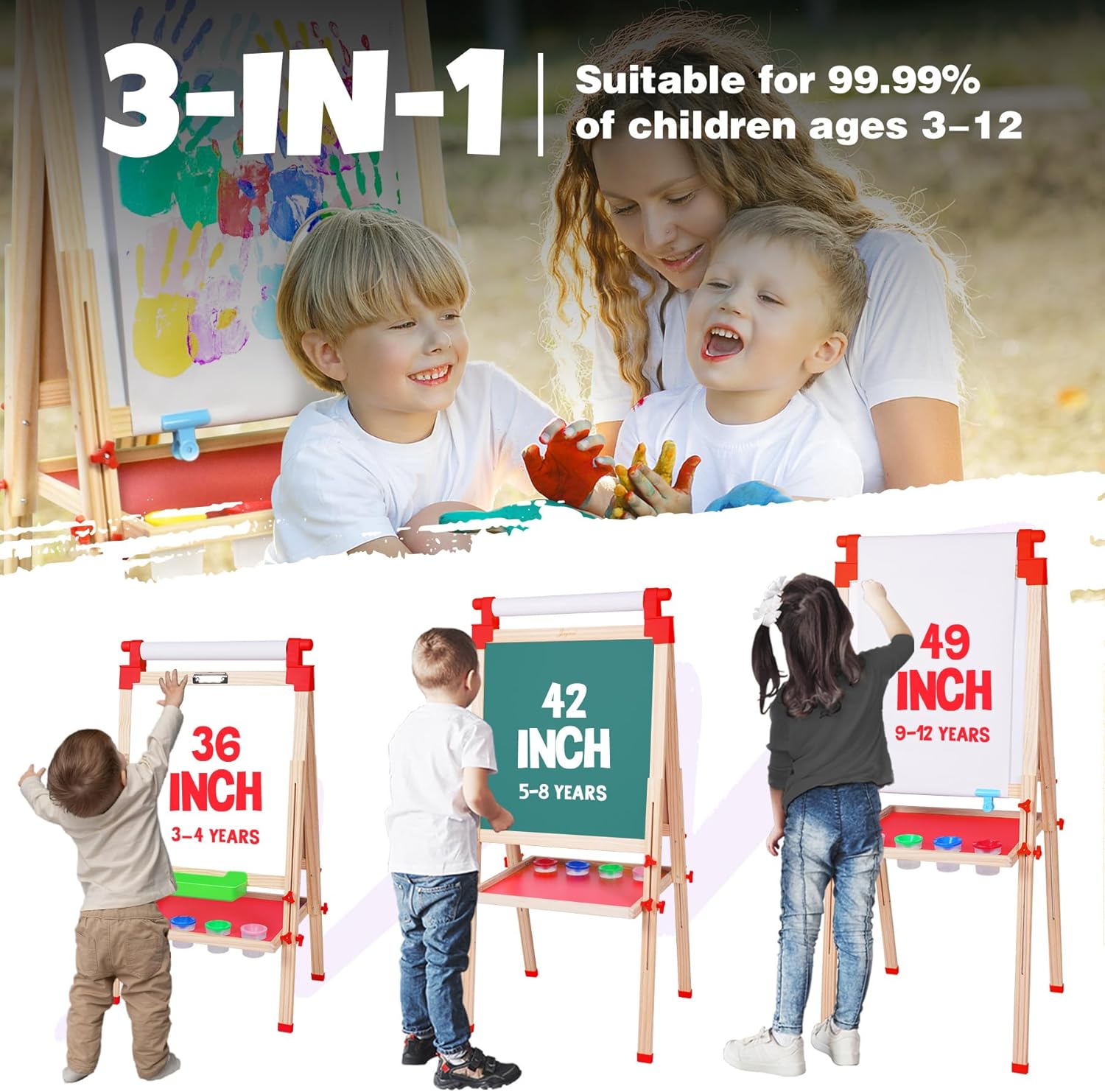
If you’ve started shopping for a kids’ art easel, you’ve already hit the first fork in the road: solid pine frames versus particle board (also called engineered wood or MDF — medium-density fiberboard made by pressing wood fibers and resin together under heat). Standalone pine easels are the classic A-frame style you picture in a preschool classroom — two legs, a chalkboard on one side, a dry-erase or whiteboard panel on the other, sometimes a paper roll holder across the top. Particle board convertible sets are the newer category: a flat-pack table and chair kit that flips or reconfigures into an easel, giving you more surface area but more assembly complexity. The practical question most parents are really asking isn’t “which material is fancier?” It’s simpler: will this thing still be standing — and still look okay — in two years? That’s exactly what this article works through, drawing on aggregated reviewer patterns and published buying-guide research rather than any single brand’s marketing copy.
| EDITOR'S PICK5-in-1 Kids Art Table and Chairs | Mid-tierJOYOOSS Kids Wooden Easel with… | Budget pickTabletop Painting Wooden Art Ea… | |
|---|---|---|---|
| Chalkboard surface | — | ✓ | ✓ |
| Whiteboard surface | — | ✓ | ✓ |
| Paper roll holder | ✓ | ✓ | — |
| Storage | Drawers | — | — |
| Intended age | — | 3–12 years | 2–4 years |
| Magnetic board | — | ✓ | ✓ |
| Price | $139.99 | $69.99 | $29.99 |
| See on Amazon → | See on Amazon → | See on Amazon → |
The Core Material Trade-Off: What Pine and Particle Board Each Actually Offer
Pine is a softwood, which means it’s lighter and easier to machine than hardwood species like oak or maple, but also meaningfully more susceptible to dents, scratches, and — critically for an art easel — staining from pigments that soak into the grain. That last point isn’t theoretical. Reviewers of the WINGYZ double-sided pine easel explicitly flag that paint and marker will stain uncoated pine if the pigment contacts the frame rail, and note wishing the frame had arrived with a factory-applied sealant or lacquer coat. The same reviewers follow that observation by describing it as a non-issue for everyday usability — which is genuinely useful nuance, not a contradiction. It means: if your child occasionally drags a wet brush across the frame, you’ll see color absorption over time. If your child stays reasonably contained to the drawing surface, pine’s natural warmth and rigidity hold up well.
Particle board sits on the opposite end of the trade-off. Its surface is sealed at the factory — typically with a melamine or vinyl laminate — so pigment absorption on non-drawing surfaces is minimal and spilled paint wipes off cleanly. The structural liability is moisture and edge damage: particle board swells when wet and chips at corners far more readily than pine. In a play environment where drinks get knocked over, that’s a real failure mode. Wirecutter’s children’s activity furniture category coverage broadly identifies edge reinforcement and laminate quality as the primary durability differentiators in particle board kids’ furniture — not the core material itself, but how well the manufacturer has protected its vulnerable perimeter.
The bottom line on materials: Pine wins on rigidity and repairability — a scratched pine rail can be sanded and re-sealed, whereas a chipped particle board edge cannot be meaningfully restored. Particle board wins on surface cleanability and resistance to paint staining on the non-drawing surfaces. Neither is categorically better; they optimize for different failure modes.
How These Easels Compare: Three Tiers of Buyer Priority
Not every family is shopping for the same thing. The comparison below organizes the two easel formats by the practical priority that should drive the decision — budget and simplicity, mid-range versatility, or long-term durability investment.
H3: Best for Budget-Minded Buyers Who Want Fast Setup
The standalone pine A-frame easel — represented in this comparison by the JOYOOSS double-sided model — is the clearest choice for parents who want low cost, fast assembly, and immediate use. Reviewers report solo assembly times of roughly 20–30 minutes with no specialized tools. The JOYOOSS model earns particular praise for cup holders integrated into the paint tray rail, a detail no manufacturer prominently markets but parents notice immediately because it meaningfully reduces the spill rate compared to flat trays. At its price point, a standalone pine easel delivers the core easel function — vertical drawing surface, dual-sided chalkboard and whiteboard, paper roll holder — without the complexity tax of a multi-configuration design.
The trade-off at this tier is longevity under heavy cosmetic use. Pine at budget price points typically ships unsealed, which means the frame rails are vulnerable to paint absorption from day one. A coat of water-based polyurethane applied before first use addresses this directly and costs under ten dollars in materials, but it’s a step the buyer has to take independently.
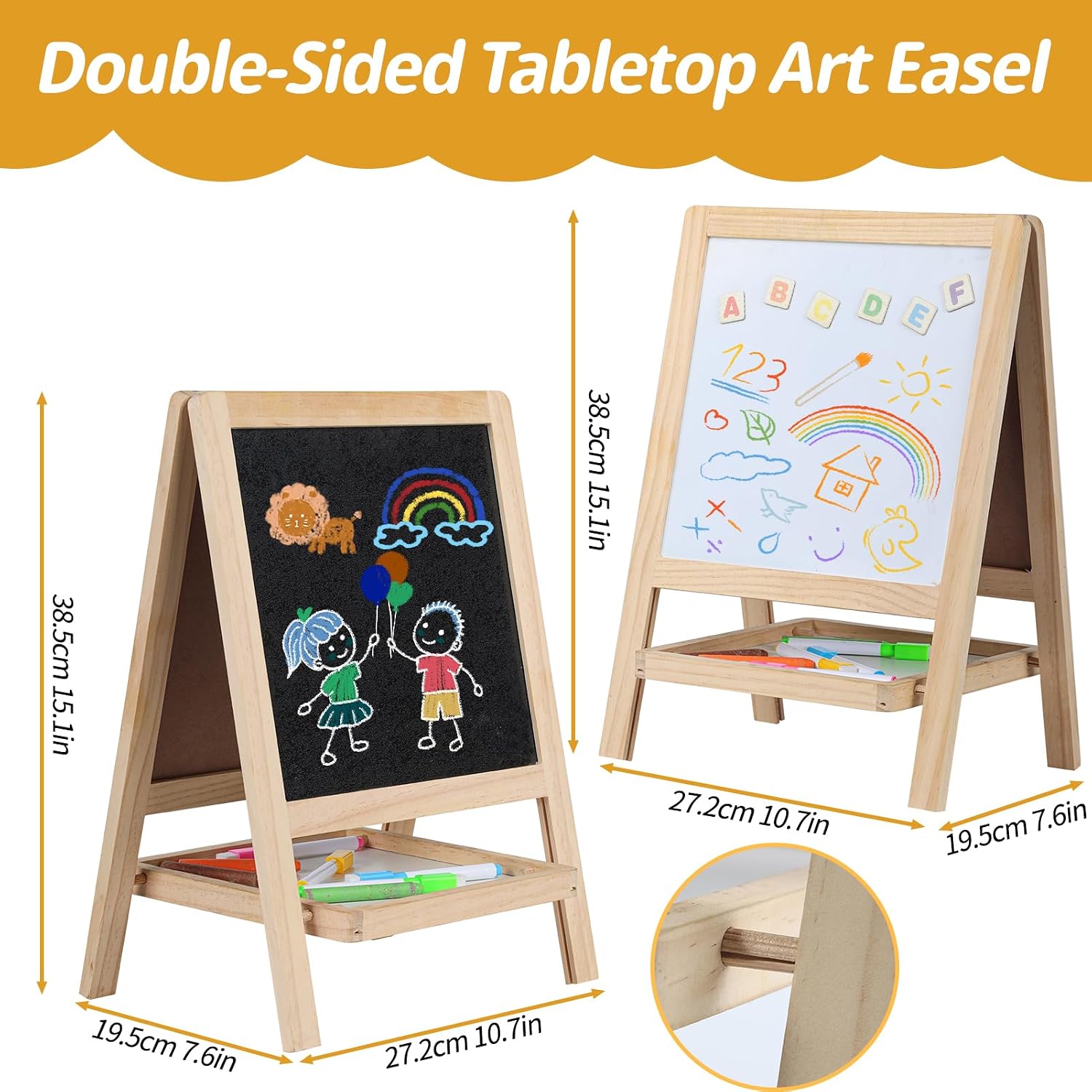
Tabletop
$29.99
In stock on Amazon
Check price on AmazonH3: Best for Families Who Want Table-and-Easel in One Footprint
The 5-in-1 convertible table-easel set — a particle board multi-configuration design that ships as a flat-pack and assembles into both a drawing table with chairs and a standing easel — targets families who have limited space and want one piece of furniture to serve multiple functions. Reviewers describe the unboxing experience as “a LOT of pieces” and “overwhelming at first,” which is consistent with what The Spruce’s 2025 “Best Kids’ Art Easels” overview identifies as a characteristic pattern for multi-configuration children’s furniture generally: part count scales with the number of use modes. The reassuring counter-signal in the reviewer record is that the same parents who describe overwhelm at unboxing then report completing solo assembly in roughly 40 minutes and confirm the finished result matches the product images closely.
In table mode, this format is inherently more stable than any floor-standing easel because the mass is lower to the ground and the base footprint is wider. In easel mode — when the top panel is raised for vertical drawing — a minority of reviewers note some front-to-back play in the hinge mechanism, though no reviewer in the aggregated record describes a tip-over event. The sealed laminate surfaces resist paint staining by design, which is the particle board format’s clearest advantage over pine in a high-use household.
JOYOOSS
$69.99
In stock on Amazon
Check price on AmazonH3: Best for Parents Prioritizing Long-Term Durability and Height Range
For families who want an easel that will remain structurally sound and functionally adjustable across multiple years of use — or across more than one child — the premium consideration is a solid pine A-frame with a verified stability cross-brace and a confirmed height adjustment range. Bob Vila’s 2025 “Best Kids’ Easels” buying guide flags height range (minimum to maximum panel height) as the specification parents most frequently wish they had checked before purchase, particularly when buying for a child who is currently young but will spend several years with the piece. Height-adjustable pine easels in this category are generally marketed for ages 2–8; the WINGYZ model offers multiple height positions via an adjustable center panel mechanism and earns consistent reviewer praise for that flexibility.
The durability argument for pine at this tier rests on repairability: a scratched or marked pine frame can be sanded and refinished. Particle board cannot be restored once its laminate surface chips or its edge swells. For a piece expected to absorb two-plus years of active toddler use and still look presentable, a sealed or sealer-treated pine frame is the more resilient long-term choice. Good Housekeeping’s 2025 “Best Art Easels for Kids” roundup recommends confirming that chalkboard and whiteboard panels are replaceable or re-surfaceable when evaluating any easel for long-term value — a consideration that favors the standalone pine format, where panels are typically standard-size hardboard sheets that can be sourced independently.
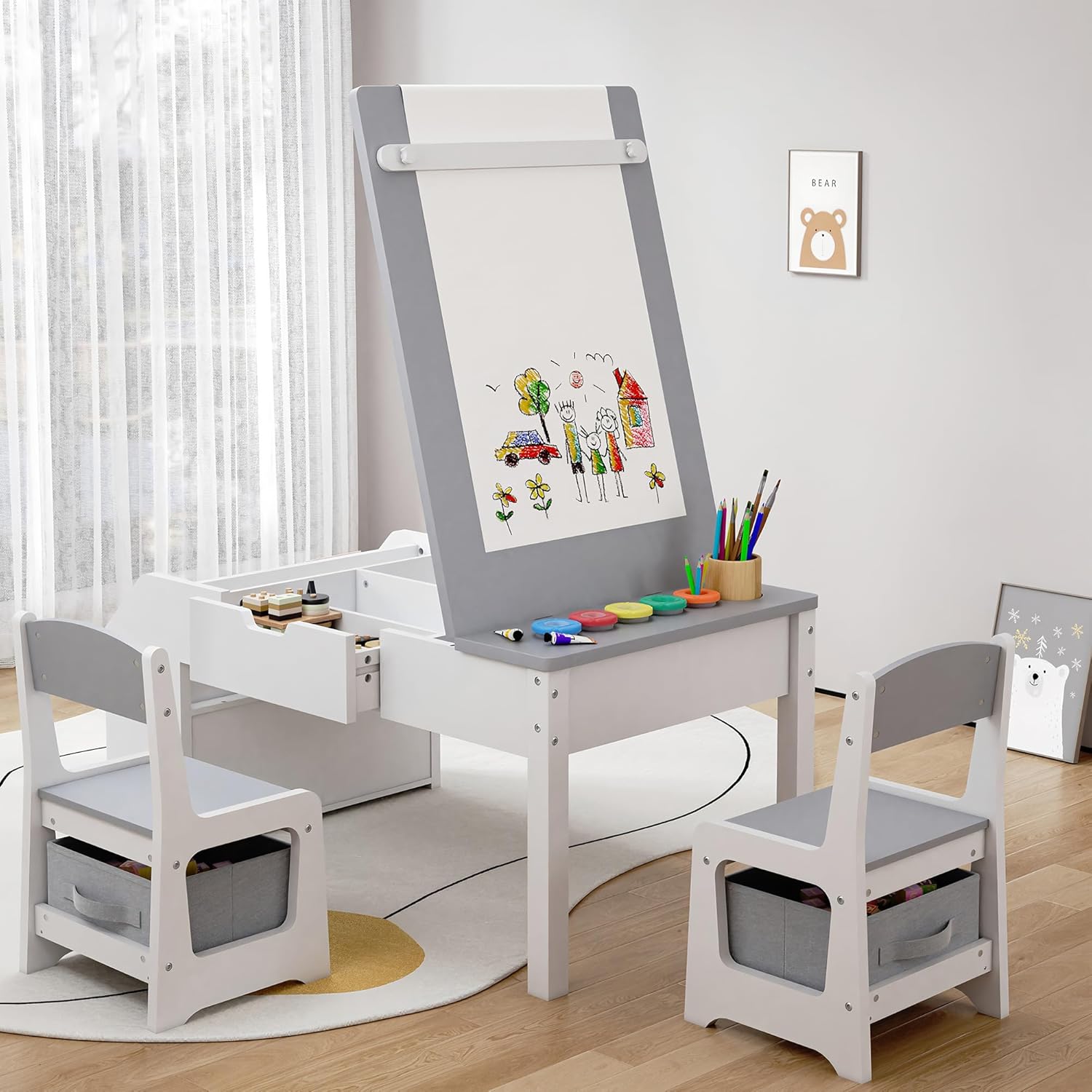
5-in-1
$139.99
In stock on Amazon
Check price on AmazonAssembly Reality Check: What the Reviewer Record Actually Shows
The assembly comparison between these two formats is less about total time and more about where the friction lands in the process.
Standalone pine easels generate consistently low-anxiety assembly reports. The JOYOOSS and WINGYZ models both follow a pattern of roughly 20–30 minutes solo, with the main complexity being the adjustable height hardware — the wing nuts or tension knobs that control panel position. Reviewers describe this as intuitive once the frame is upright.
Convertible table-easel sets front-load the difficulty at the unboxing stage. The part count for a 5-in-1 configuration is genuinely high, and reviewers consistently name this as the point of maximum stress. What the same reviewers also consistently report is that the build resolves faster than expected once underway, with a solo completion time around 40 minutes and a result that matches expectations.
By the numbers:
| Format | Typical Solo Assembly Time | Part-Count Anxiety | Result Confidence |
|---|---|---|---|
| Standalone pine easel | 20–30 min | Low | High |
| 5-in-1 convertible set | ~40 min | High at unboxing | High once complete |
If you are assembling the night before a gift reveal and want zero surprises, the standalone pine easel is lower variance. If you have 90 minutes and want a multi-use piece, the convertible set’s complexity is front-loaded and resolves cleanly according to the reviewer record.
Stability Under Toddler Use: Structural and Surface Questions Answered
Structural stability consistently favors the standalone pine A-frame design. The geometry — two legs spreading outward at the base — is inherently self-bracing. Reviewers across both the WINGYZ and JOYOOSS lines report no tipping incidents with children in the 18-month to 5-year range during normal use. The caveat is “normal use”: a child leaning their full upper-body weight against the top rail will challenge any floor-standing easel’s center of gravity. Easels that include a lower cross-brace or stability bar earn consistently stronger stability reviews than those without one; this is worth confirming in the product specifications before purchase.
Surface durability at two years reconnects to the staining question raised earlier. If pine frame rails absorb paint and marker over two years of regular use, the structural integrity is almost certainly unaffected — pigment absorption doesn’t compromise pine’s rigidity. The cosmetic picture is different. Parents with lower tolerance for a “well-loved” patina should either apply a clear polyurethane sealant to the pine frame rails before first use or lean toward a particle board convertible where the sealed laminate surfaces resist staining by design.
Wirecutter’s children’s activity furniture guidance emphasizes that surface durability in this category is primarily a function of finish quality rather than core material — which means a well-finished pine easel and a well-laminated particle board set can perform comparably on surface survival, while a poorly finished version of either will show wear faster regardless of what the frame is made of.
Frequently Asked Questions
Can a 2-year-old flip a double-sided pine easel independently?
A verified WINGYZ reviewer confirms that their 2-year-old can independently flip between the chalkboard and whiteboard sides without adult help. This suggests the flip mechanism on well-designed double-sided pine easels is light enough for toddler hands — but toddler motor development varies enough that we’d treat this as a “it’s possible” signal rather than a guarantee. Look for easels where the flip is secured by a friction lock rather than a clip or latch; friction locks are consistently easier for small hands.
Will paint stain the wood frame on a pine easel?
Yes, according to aggregated WINGYZ reviewer reports: liquid paint and wet markers will absorb into raw pine if they contact uncoated frame rails or tray surfaces. The degree of staining depends on how much spillover reaches the wood. Applying water-based polyurethane to the frame before first use is the simplest preventive measure. Reviewers who skipped this step describe the staining as cosmetic only — it doesn’t affect usability.
How does assembly time compare between the two formats?
Standalone pine easels (JOYOOSS and WINGYZ style) typically run 20–30 minutes solo. The 5-in-1 convertible table-easel set runs roughly 40 minutes solo, with the primary difficulty being initial part-count overwhelm rather than any single complicated step. Both formats are consistently described as manageable for one adult working alone.
Does the paper roll holder prevent spills?
The paper roll holder is structural and holds a standard art paper roll for tear-off drawing — spill prevention is a function of the paint tray design, not the paper holder. The JOYOOSS easel earns specific reviewer praise for cup holders integrated into the paint tray that stabilize paint containers and reduce tip-over risk. Not all easels in this category include this feature; if spill management is a priority, confirm whether the tray has cup dividers before purchase.
At what age do children typically outgrow a height-adjustable easel?
Height-adjustable standalone easels in this category are generally marketed for ages 2–8. The Spruce’s 2025 “Best Kids’ Art Easels” overview notes that children typically transition away from standalone easels when they prefer sitting at a table for art projects — less a physical height limitation than a preference shift, often around ages 6–8.
Are the chalkboard and dry-erase panels on pine easels replaceable?
In most cases, yes — though not through a branded spare-parts program. The chalkboard and whiteboard panels on standalone pine easels are typically thin hardboard sheets screwed or pinned into the frame, meaning a motivated adult can unscrew and replace them with standard-size panels available from art supply vendors or hardware stores. Good Housekeeping’s 2025 “Best Art Easels for Kids” roundup recommends confirming panel replaceability when evaluating any easel for long-term value. In practice, few reviewers report needing to replace panels within the standard review timeframe; most describe the surfaces holding up adequately under regular use.
All assembly time estimates, stability observations, and material behavior claims in this article are drawn from aggregated reviewer and parent reports and from editorial coverage by The Spruce, Good Housekeeping, Wirecutter, and Bob Vila — not from independent product testing by this publication. We synthesize the published record; we do not own or lab-evaluate the products we cover. Affiliate relationships are disclosed in our site-level transparency statement.