August 9, 2026 • Maren Calloway • 9 min reading time • Prices verified June 6, 2026
Chalkboard Table Surfaces for Toddlers: Reversible Tops, Flip Lids, and What Holds Up at Year Two
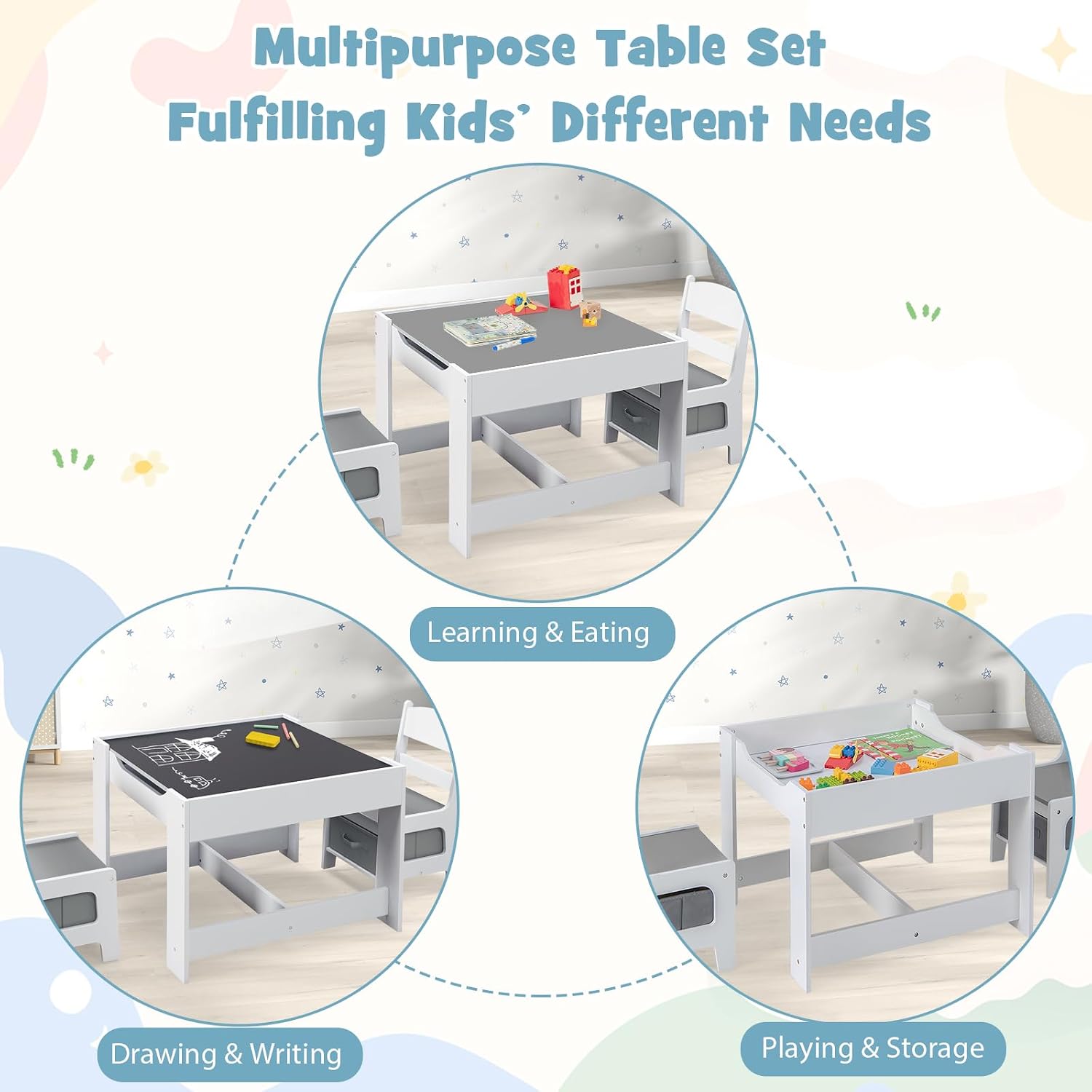
If you’ve ever watched a two-year-old drag a crayon across a surface that was definitely not meant for crayons, you already understand the pitch for a dedicated toddler chalkboard table. These are small, kid-height activity tables — typically designed for ages 2 through 6 — where the tabletop can be written on with chalk or chalk markers, then wiped clean. Many of the most popular models add a reversible top, meaning you can flip the surface to expose a plain whiteboard, a dry-erase panel, or a smooth play surface depending on what the day calls for. The smarter designs also tuck storage into the chair seats, a side bookcase rail, or a cavity beneath the top itself. This guide is for parents, educators, and anyone with a purchase decision currently in motion: we synthesize aggregated owner reviews, published spec comparisons, and real long-run feedback to help you figure out which designs still look like a good idea at the two-year mark — and which ones quietly disappoint.
The Material Reality: What “Chalkboard Surface” Actually Means on a $40–$120 Table
Let’s be direct: at this price tier, you are almost never buying a slate chalkboard surface. Slate — the dense natural stone used in traditional schoolroom chalkboards — is heavy, expensive, and structurally incompatible with the lightweight frames required to keep a toddler table from becoming a hazard. What you’re buying is a chalk-painted MDF panel. MDF (medium-density fiberboard) is an engineered wood product made from compressed wood fibers; it’s smooth, stable, and takes chalkboard paint evenly, which is why it dominates this category. A properly finished MDF chalk surface can perform nearly identically to slate for standard chalk use, but the comparison breaks down when liquid chalk markers enter the picture — more on that in the FAQ.
The practical implication: surface quality across these tables is driven less by material category and more by coating thickness and finish consistency. Reviewers across multiple products consistently flag chalkboard panels that arrived with thin, streaky coverage as prone to ghosting (the faint shadow a drawing leaves behind even after erasing — more on seasoning below). Tables where the panel is a separate laminated insert rather than a painted-in-place surface tend to receive better long-run marks, because a worn panel can theoretically be replaced or resurfaced without replacing the table.
Seasoning — the process of rubbing the flat side of a chalk stick across the entire surface, then erasing, before first use — is a load-bearing concept here. It fills the microscopic pores in the coating so your child’s first drawing doesn’t embed itself permanently. Consumer Reports’ 2024 kids’ furniture safety and durability overview notes that skipped or partial seasoning is the single most common cause of early ghosting complaints on chalk-painted wood surfaces. Every table in this guide benefits from it.
The Four Tables Worth Naming (and What the Long-Run Record Shows)
Costzon 3-in-1
The Costzon 3-in-1 occupies the high-volume entry point of this category, and its owner record is notably consistent. A former preschool teacher’s review — cited across multiple aggregator sites including a 2025 Good Housekeeping roundup of kids’ art tables — specifically calls out the frame sturdiness and ease of assembly. The “3-in-1” designation refers to configurable use modes rather than a single reversible panel, but the chalkboard surface receives strong marks for uniformity.
The durability proxy worth noting: multiple independent reviewers report that parents sat in the accompanying chairs to test stability before handing them to their kids. This is actually meaningful stress-test data. A chair rated for a 30–50 lb toddler that holds a 150 lb adult without flexing is demonstrating a significant safety margin. Across Costzon reviews, the chair-test pass rate is high.
Kinder King
Kinder King earns consistent praise for what reviewers call genuine utility in its storage architecture — and here, “genuine” is doing real work. Many toddler tables advertise storage that turns out to be decorative or too shallow for practical use. Kinder King owners specifically call out the removable and reversible tabletop, the under-top storage cavity, the side bookcase rail, and the under-chair bins as features they use in daily rotation rather than once-a-month novelties. The Spruce’s 2025 toddler table roundup flags the reversible mechanism as one of the cleaner implementations in this price band.
The critical question with reversible tops is whether the locking mechanism loosens over time. Kinder King’s design uses a seated-insert system rather than a hinge-and-latch; owner reviews at the 9–12 month mark describe the fit as still snug, though a small number of reviewers at or past 18 months note the insert becoming marginally easier to pop out — which could be read as either loosening or as a deliberate low-resistance design choice for small hands.
GTOLV
GTOLV has the most compelling long-run data point in this roundup: at least one verified owner review specifically documents two years of daily use with no wobble and easy liquid chalk cleanup. That’s a rare claim in a category where most feedback clusters in the first 90 days post-purchase. Apartment Therapy’s 2024 activity table guide notes that toddler furniture durability tends to be underreported after the first-year excitement fades, which makes multi-year owner accounts disproportionately valuable.
The liquid chalk cleanup note is particularly useful because it confirms that GTOLV’s surface handles marker-weight pigment without the deep staining some MDF surfaces develop. Whether that performance persists if a child uses non-washable markers is a different question — but for chalk markers specifically, the two-year owner confirms the surface holds up.
VEVOR Montessori Table
The VEVOR Montessori table solves a problem the other three don’t directly address: height adjustability across developmental stages. Reviewers note three distinct chair-height settings, and the transition window reviewers call out — from high-chair age into independent table use — maps to roughly ages 18 months through 4 years. That’s a meaningful longevity multiplier. A fixed-height table that fits a 2-year-old perfectly may require a booster at age 18 months and feel cramped by age 4; an adjustable frame extends the useful window by 12–18 months on either end.
The tradeoff: adjustable-leg mechanisms introduce a potential failure point that fixed frames don’t have. VEVOR owner reviews don’t flag leg-adjustment issues at scale, but it’s worth noting that the 2-year durability record that GTOLV has accumulated isn’t yet as broadly documented for VEVOR in public review pools.
By the Numbers
| Table | Reversible Top | Height-Adjustable | Long-Run Review (≥2 yr) | Adult Chair-Sit Reports |
|---|---|---|---|---|
| Costzon 3-in-1 | No | No | Not documented | Multiple positive |
| Kinder King | Yes (insert) | No | Not documented | Multiple positive |
| GTOLV | No | No | Yes (confirmed 2 yr) | Implied pass |
| VEVOR Montessori | No | Yes (3 settings) | Not documented | Not reported |
The Decision Frame: Which Table for Which Situation
This is where the if/then logic earns its keep.
If your primary concern is long-run structural durability and you want the most evidence: GTOLV is the pick. Two years of daily use without wobble is the strongest single data point in this field, and the confirmed liquid chalk cleanup performance matters if your child is old enough to use markers rather than stick chalk.
If storage architecture and reversible functionality matter more than long-run documentation: Kinder King is the pick. The reversible insert, the bookcase rail, and the under-chair bins are consistently reported as genuinely useful — not marketing features. Accept that the insert mechanism may marginally loosen past 18 months and decide whether that’s tolerable.
If you’re buying for a child under 2 or anticipate a significant height transition: VEVOR’s adjustability extends the useful life of the table in a way no other model in this roundup matches. The three height settings are a real longevity feature, not a spec-sheet line.
If you’re in an institutional or classroom context (a daycare, a preschool activity corner): Costzon’s preschool-teacher endorsement and consistent chair-stability reports make it the most defensible commercial-adjacent pick at this price. It’s not NSF-rated (that standard — the National Sanitation Foundation’s food-contact-surface certification — applies to commercial food service, not play furniture), but the sturdiness track record matters in high-use environments.
Frequently Asked Questions
Can liquid chalk markers be used on these reversible chalkboard tops without ghosting?
It depends on the surface and whether it was properly seasoned first. Standard chalk markers — the water-based kind — clean up with a damp cloth on a well-seasoned MDF surface, and GTOLV’s two-year owner confirms this. Oil-based or permanent chalk markers are a different story: they can stain MDF coatings permanently. The Spruce’s 2025 guide recommends testing any new marker in a corner before committing to full-surface use. Seasoning (rubbing chalk sideways across the full surface before first use, then erasing) is essential regardless of marker type.
Do the chair-seat storage bins hold up after months of kids sitting on them repeatedly?
Across Kinder King reviews specifically, chair-seat bins receive positive durability marks through the first year. The sitting load — even accounting for occasional adult weight-testing — doesn’t appear to compromise bin structure in the majority of documented reviews. That said, the bins are MDF or laminated particleboard; repeated moisture exposure (wet swimsuits, spilled drinks) is a faster failure path than weight alone.
Is the chalkboard surface on these tables real chalkboard material or just painted MDF?
It’s chalk-painted MDF in every case reviewed here. As noted above, that’s not a disqualifying fact — well-finished MDF chalk surfaces perform comparably to slate for everyday use. The practical differences show up in edge durability (MDF corners chip more readily than slate) and in surface recovery after deep staining. Consumer Reports’ 2024 durability overview confirms MDF dominates the sub-$150 kids’ furniture segment for this reason.
At what age do kids typically outgrow a fixed-height toddler chalkboard table?
Good Housekeeping’s 2025 kids’ art table guide pegs the typical useful window for fixed-height toddler tables at ages 2–6, with fit becoming uncomfortable for most kids around the 5–6 year range as leg clearance tightens. Height-adjustable designs (VEVOR’s three settings) push the upper bound toward age 7 in some cases. The lower bound is more about developmental readiness than size: most children aren’t using a seated activity table independently before 18–24 months.
Does the reversible tabletop mechanism stay secure, or does it loosen over time?
The Kinder King insert system shows marginal loosening in a subset of reviews at or past 18 months — reviewers describe it as easier to pop out rather than structurally failed. No hinge-based reversible top in this category has long-run documentation as strong as GTOLV’s fixed-surface record. If a fully secure, non-moveable surface is your priority, a fixed-top table is structurally simpler and has fewer failure points. If the reversibility is genuinely useful to your household, Kinder King’s insert design is the most-reviewed implementation in this tier.
We synthesize published reviews, manufacturer specs, and aggregated owner feedback — we don’t own or independently test these products. Affiliate relationships are disclosed in our site-wide affiliate policy.