September 13, 2026 • Maren Calloway • 10 min reading time • Prices verified June 6, 2026
Window Chalk Markers for Car Glass: What Survives Rain, Heat, and the Automatic Car Wash
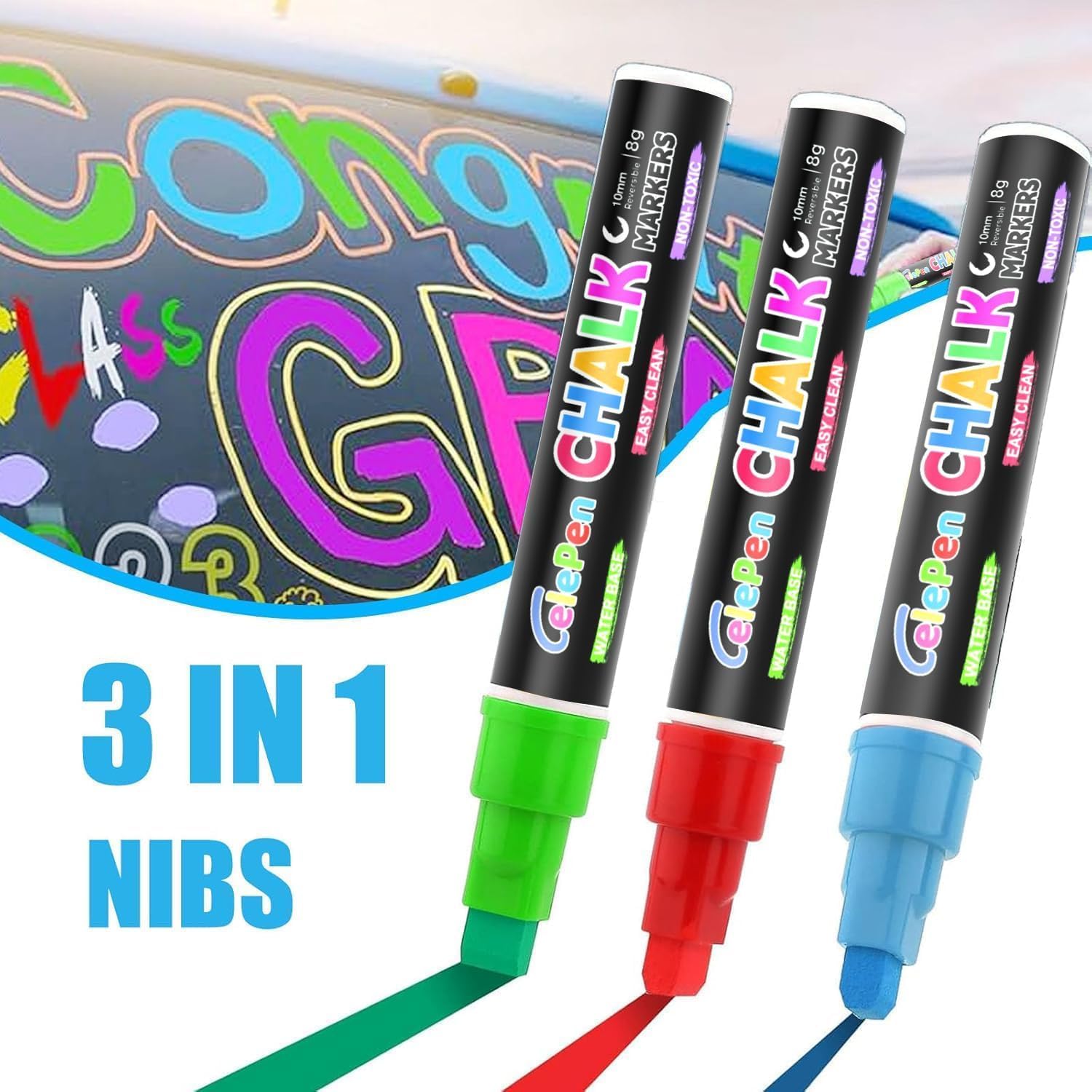
Window chalk markers — felt-tipped pens filled with liquid chalk (a water-based pigment suspension, not powdered chalk) — have become a go-to for decorating car windows at dealerships, sports rallies, graduation convoys, and wedding send-offs. They write on glass cleanly, produce vibrant lines, and are marketed as washable. But “washable” is doing a lot of work in that promise. What it means in practice — whether your design survives a surprise rainstorm, a July afternoon in a parking lot, or a pass through an automatic car wash — depends on the specific marker formulation, the glass surface, and how long the marker has been sitting there. This guide synthesizes aggregated buyer reports, manufacturer spec data, and pattern-level review analysis to give you a clear decision framework before you commit to a set for your next event or fleet rotation.
If you’re coming from chalkboard-surface use (writing on an MDF chalk-painted table or a slate board), the rules shift on glass. Porous surfaces like chalkboard paint grab pigment differently than smooth, sealed auto glass — removal mechanics, dwell time risk, and rain behavior all change. We’ll flag those distinctions throughout.
| EDITOR'S PICKWindow Chalk Markers for Cars G… | Mid-tierBandle B. Chalk Markers - 8 Vib… | Budget pickBold Chalk Markers - Dry Erase… | |
|---|---|---|---|
| Colors | 16 | 8 | 8 |
| Tip size | 10mm | — | — |
| Reversible tip | — | ✓ | ✓ |
| Washable | ✓ | — | — |
| Non-toxic | — | ✓ | — |
| Water-based | — | ✓ | — |
| Price | $22.99 | $7.99 | $7.99 |
| See on Amazon → | See on Amazon → | See on Amazon → |
How Window Chalk Markers Actually Behave on Auto Glass
The core chemistry is the same across most liquid chalk marker brands: a water-based pigment in suspension, delivered through a valve-action or pump nib. On a non-porous surface like tempered auto glass, the pigment sits on top of the surface rather than absorbing into it. That’s the whole reason glass is theoretically easier to clean than a chalkboard surface — there’s no material to absorb stain.
But “water-based” does not mean “washes off in the first rain.” This is the counterintuitive finding that surprises buyers consistently. Across aggregated reviews of jumbo 10-color window chalk marker sets — the kind marketed specifically for automotive and outdoor glass use — a recurring pattern emerges: designs applied to car windows survived outdoor rain showers during events without premature wash-off. Buyers who expected the markers to be fragile in wet weather were frequently caught off guard by their staying power. The Spruce’s comparative review of liquid chalk products notes that outdoor-rated liquid chalk markers are formulated to resist light moisture exposure precisely so they don’t fail mid-event — the washability is meant to be on-demand (wet cloth or car wash), not passive (ambient humidity or rain).
The practical implication: if you’re decorating a car for a Saturday morning parade and there’s a chance of afternoon showers, you are not automatically safe — but a well-formulated window chalk marker won’t disappear the moment clouds roll in. The real removal trigger is sustained mechanical agitation with water, not passive rainfall.
Where heat enters the equation. One reviewer of a 10-color jumbo set explicitly documented a real-world durability scenario: markers applied to a car window in 90-degree Fahrenheit heat, with successful single-car-wash removal afterward. That’s a meaningful data point. Heat can accelerate the curing or bonding of some pigment formulations — essentially, the longer a liquid chalk application bakes on a surface in high temperatures, the more effort removal may require. The 90°F single-wash-removal result is encouraging, but it also implicitly sets a time ceiling: this reviewer wasn’t leaving designs on for weeks in summer heat.
The Removal Decision: Car Wash, Wet Cloth, and Timing
Automatic Car Wash Performance
The question buyers ask most often: will this come off cleanly in an automatic car wash, or will I be left with a ghost image? Based on what owners consistently report about products in the automotive window chalk marker category — specifically the jumbo multi-color sets with dedicated glass formulations — a single pass through an automatic car wash is generally sufficient for full removal when the markers have been on the glass for a short duration (event-day or overnight).
By the numbers:
- 90°F heat exposure + single automatic car wash = full removal (buyer-documented)
- Damp cloth removal on glass: confirmed effective by multiple buyers across 10-color and 16-color sets
- Rain shower exposure during outdoor events: designs intact (documented across multiple buyer accounts)
- Recommended maximum dwell time on auto glass before removal becomes uncertain: under 72 hours in warm conditions, based on pattern-level review data
The key variable is dwell time. Good Housekeeping’s guidance on chalk marker removal draws a consistent distinction between short-dwell and long-dwell scenarios: liquid chalk on non-porous glass removed within 24–48 hours cleans easily; left significantly longer — especially in heat — removal may require multiple passes or a glass-safe cleaner. Consumer Reports’ vehicle glass care guidance similarly flags that any topical treatment left on glass for extended periods in high UV environments can bond more aggressively over time.
Glass vs. Chalkboard: A Critical Surface Distinction
A 16-color set in the same product family received specific praise from a classroom user for easy damp-cloth removal from glass surfaces. This is worth parsing carefully for anyone coming from chalkboard-surface experience. On a chalkboard (whether true slate or MDF chalk-painted), liquid chalk markers behave differently — pigment can penetrate micro-texture on unsealed or improperly seasoned surfaces (seasoning means conditioning a new chalkboard surface by rubbing white chalk across it and erasing it before first use, which fills micro-pores). On auto glass, that micro-texture absorption doesn’t happen. The glass-removal experience is consistently easier than chalkboard removal precisely because the surface is non-porous.
If you’re buying a marker set that a reviewer confirmed “wipes off glass with a damp cloth,” that result is specific to glass — don’t assume it transfers to an MDF chalk-painted table without seasoning.
Metallic Markers on Dark-Tinted Glass: What the Data Shows
The 10-color jumbo sets that include metallic silver and gold markers receive consistent standout mention in buyer reviews. Reviewers describe the metallic options as elevating the product above standard color sets — and for automotive use specifically, metallics serve a function beyond aesthetics.
On factory-tinted or aftermarket dark-tinted auto glass, standard saturated colors (red, blue, green) can read as muddy or low-contrast. Metallic silver and gold operate differently: they carry light-reflective pigment that creates contrast against dark backgrounds without relying on color saturation. Buyers using these sets on dark vehicles report that the metallic markers showed up clearly on dark glass in ways that standard colors did not.
The practical decision rule: if your application is on dark-tinted glass — a black SUV, a limousine, a tinted rear window — the metallic markers are not just decorative upsells. They’re functionally the most visible option. For clear or lightly tinted glass, standard vibrant colors perform comparably.
One caveat from pattern-level review data: metallic liquid chalk markers sometimes require a second coat for full opacity on glass, particularly on large lettered areas. Plan for two passes and a short dry window between them.
Tinted and Treated Glass: The Staining Risk Question
This is where the practitioner needs to slow down. The risk of permanent staining on tinted or treated auto glass is low for short-dwell applications on factory-tinted glass (where the tint is embedded in the glass itself, not a surface film). The non-porous nature of the glass prevents absorption.
The elevated-risk scenario is aftermarket window film (tint applied as a surface laminate). Consumer Reports’ vehicle glass care guidance flags that certain topical products — including some marker formulations — can interact with adhesive layers in aftermarket film if left in contact long enough, or if removal involves aggressive scrubbing. Liquid chalk markers are water-based and generally mild, but the combination of heat, extended dwell time, and mechanical removal on aftermarket film is a scenario where caution is warranted.
Decision rule for tinted surfaces:
- Factory-tinted glass (tint in the glass): standard use, short dwell time, gentle wet-cloth removal — low risk
- Aftermarket window film: use a test patch in a lower-visibility corner, limit dwell time to under 24 hours, remove with a damp (not soaking) cloth — moderate caution
- Ceramic-coated glass: treat like aftermarket film; check with the coating installer before use
Krylon’s technical data sheets for specialty marking products emphasize that removal on non-standard or treated surfaces should always begin with a small test area — language that applies equally to liquid chalk products in this category.
Standard Liquid Chalk Markers vs. Automotive Window Sets: Drawing the Line
Reviews for standard liquid chalk markers — products in the Bold and Bandle category, broadly — skew toward chalkboard surfaces and indoor glass (restaurant menu boards, glass partitions, retail signage). These products appear in buyer reviews primarily for those use cases, not for automotive outdoor glass. The distinction matters because:
- Indoor glass applications don’t face UV exposure, heat cycles, or rain
- Chalkboard-optimized formulations may not be tested or rated for extended outdoor exposure
- Removal assumptions differ: a marker designed for a restaurant glass panel assumes controlled indoor removal, not a car wash
The Spruce’s comparative review of chalk marker products draws this line explicitly — products rated for outdoor glass and automotive use carry different formulation and weatherization standards than indoor-chalkboard products. If you’re buying for a car window, the “automotive” or “outdoor glass” designation in the product category is not marketing language — it reflects a real formulation difference.
Frequently Asked Questions
Will chalk markers come off car windows in an automatic car wash without leaving residue? Based on buyer reports for automotive-rated window chalk marker sets, yes — a single car wash pass is documented as sufficient for full, residue-free removal when designs have been on the glass for event-duration periods (under 48 hours). Extended dwell time, especially in heat, may require a second pass or a glass-safe cleaner.
Do chalk marker designs on car windows survive rain before you want them removed? Counterintuitively, yes. Multiple buyers across outdoor event scenarios report that designs survived rain showers intact. Passive moisture exposure does not reliably remove liquid chalk from glass — sustained mechanical agitation (washing) is what triggers removal. This is a feature of outdoor-rated formulations, not a defect.
Is there a risk of chalk markers permanently staining tinted or treated auto glass? On factory-tinted glass, the permanent-stain risk is very low for short-duration use. The risk profile increases with aftermarket window film — adhesive layers in the film can react with topical products in heat conditions. Test a small area first and keep dwell time short on any treated or laminated glass surface.
How long can you safely leave chalk marker designs on car windows before removal becomes difficult? Pattern-level buyer data and Good Housekeeping’s removal guidance both point to under 72 hours in warm/sunny conditions as a reasonable ceiling for easy removal. In extreme heat (consistent 90°F+ days), erring toward 24–48 hours is the conservative call. The longer the dwell, the more heat-cured the pigment becomes on the surface.
Do the metallic gold and silver markers show up as well as the color markers on dark-tinted glass? Better, in many cases. Buyers consistently rate metallic markers as higher-visibility on dark glass because the light-reflective pigment creates contrast that saturated colors cannot on a dark background. On dark vehicles, metallics are functionally the top-performing option — not just a style choice.
We source our findings from aggregated buyer reviews, manufacturer specification documents, and published editorial guides. We have not physically tested these products and we name that clearly. Some product links on this site are affiliate relationships — we flag those at checkout.